Pro-Delcy content from “Hispan Online” generated over 47 million YouTube views and 11,391 articles in a single month. Traces point to an Argentine firm
Caracas Chronicles
PARA LA HORA DE VENEZUELA
Behind a network of fake YouTube newscasts spreading propaganda in favor of Venezuela’s acting president, Delcy Rodríguez, lies a hidden digital structure made up of dozens of websites and social media accounts. It is a much larger and still-active operation than initially believed, designed to distribute content as if it came from independent regional outlets.
In two previous reports, Cazadores de Fake News named this influence operation “Hispan Online.” The first revealed part of the network of YouTube channels whose videos appeared as ads on Venezuelan screens, pushing narratives favorable to the Rodríguez administration. The second report confirmed that the “anchors” were not journalists, but more than 20 actors living in Argentina who were hired through an intermediary agency. The videos racked up millions of views.
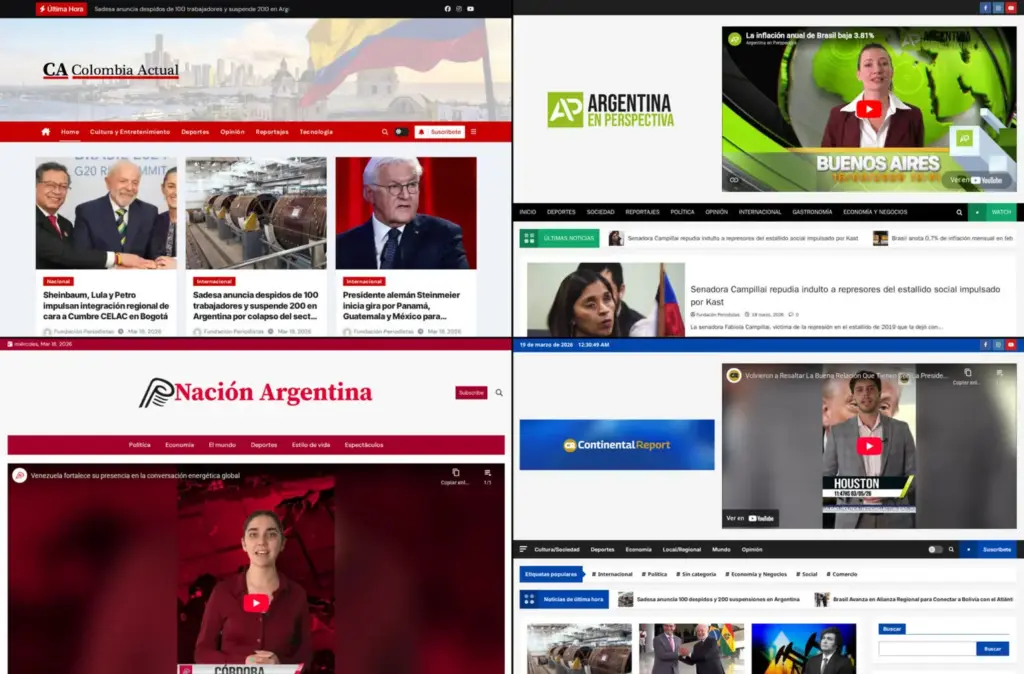
The channels mimic Spanish-language news outlets, presenting their content as if it were multiple spontaneous local coverages. So far, Cazadores has identified: Hispan Online (the most prolific producer and the network’s central amplification node), Nación Argentina, Colombia Actual, Panorama Colombiano, La Perspectiva Global, México en Datos, Informe Mexicano, United Data News, Continental Report, Nación Digital MX, Chile en Datos, Argentina en Perspectiva, EC En Análisis, and El Informe Europeo. All of them are part of the network identified so far as the YouTube arm of the operation.
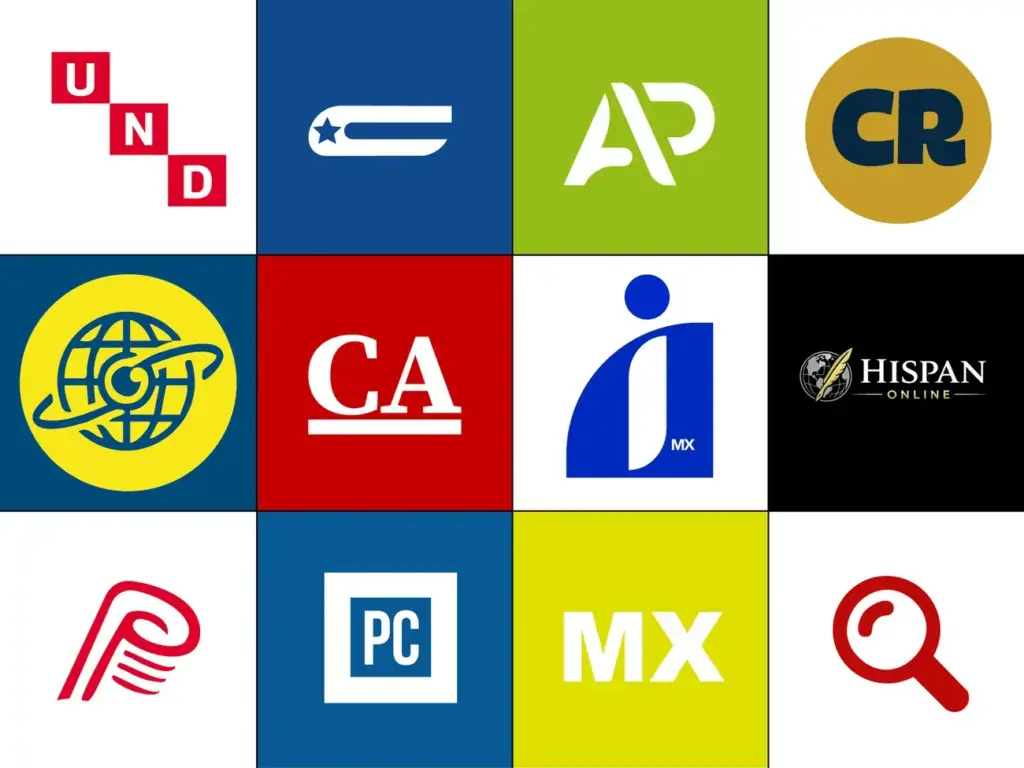
But Venezuelans exposed to those videos are largely unaware that the operation extends far beyond YouTube. At least 30 websites were created as part of it, publishing more than 11,000 articles in just one month. Each site links to Instagram, Facebook, and YouTube accounts bearing the same names as the fake newscasts.
Domain records for some of these websites identify QSocial, an Argentine political communications firm, as the registrant of several of them. A separate investigation by La Nación points in the same direction.
YouTube channels as the tip of the iceberg
The propaganda videos promoted through YouTube ads amassed millions of views, but the 14 channels that initially hosted them hardly resembled real news outlets. Most displayed little more than a logo, and their videos were often not publicly listed.
Some channels, however, included short descriptions and, in some cases, a website address—such as colombiaactual.co for “Colombia Actual” and nacionargentina.info for “Nación Argentina.”
Ongoing monitoring of F. G. Medios S.A. (the company that paid for the YouTube ads) through Google’s Ads Transparency Center led to the identification of 30 distinct YouTube channels. Together, they published at least 90 videos and amassed more than 47.5 million views. Following the pattern of the web addresses, additional associated sites were expected: Manual searches confirmed 30 corresponding websites.
At least five of these sites embedded YouTube playlists or windows featuring the same fake “journalists” seen in the ads.
All 30 domains with known registration dates were created within just nine days, between February 17 and 25, 2026. Fourteen were registered on February 20 alone. This pattern mirrors the creation of the YouTube channels, which appeared between February 18 and early March. The clustering of dates is one of several technical indicators of coordination in this influence operation.
The sites also share a common technical architecture. All run on WordPress, use Cloudflare servers, were registered via Dattatec or DonWeb, use themes developed by Ansar, and have the same Jetpack plugin installed. Articles across all sites are published by the same three WordPress users: “administrador,” “periodista 1,” and “periodista 2.”
This is not a network of independently built websites. It is a single model replicated 30 times and operated by the same group. In total, the network includes more than 90 social media accounts: 30 YouTube channels, 32 Instagram accounts, and 29 Facebook pages. As of publication, most have minimal activity and almost no followers—but the infrastructure is in place and regularly updated.
Venezuela content stands out
With 30 active websites identified, the next step was to analyze their content. Reviewing each article manually was not feasible at that scale.
To do so, Cazadores de Fake News developed a tool—with assistance from generative AI—capable of automatically downloading all articles published across the 30 sites, including full text and images. The result was a database of 11,391 articles produced in just one month.
While most articles are not about Venezuela, it is the most frequently referenced country. With 1,912 pieces, Venezuela accounts for 16.79% of all content, ahead of Brazil (14.30%), Colombia (8.83%), Mexico (8.79%), and Argentina (8.12%). The rest covers other countries, helping each site appear as a regional outlet with its own editorial agenda.
Much of the Venezuela-related content mirrors the narratives promoted in the YouTube ads: favorable coverage of Delcy Rodríguez and her brother Jorge Rodríguez (who presides the Venezuelan parliament), reporting on the new amnesty and hydrocarbons laws, and stories highlighting positive economic projections and the oil sector.
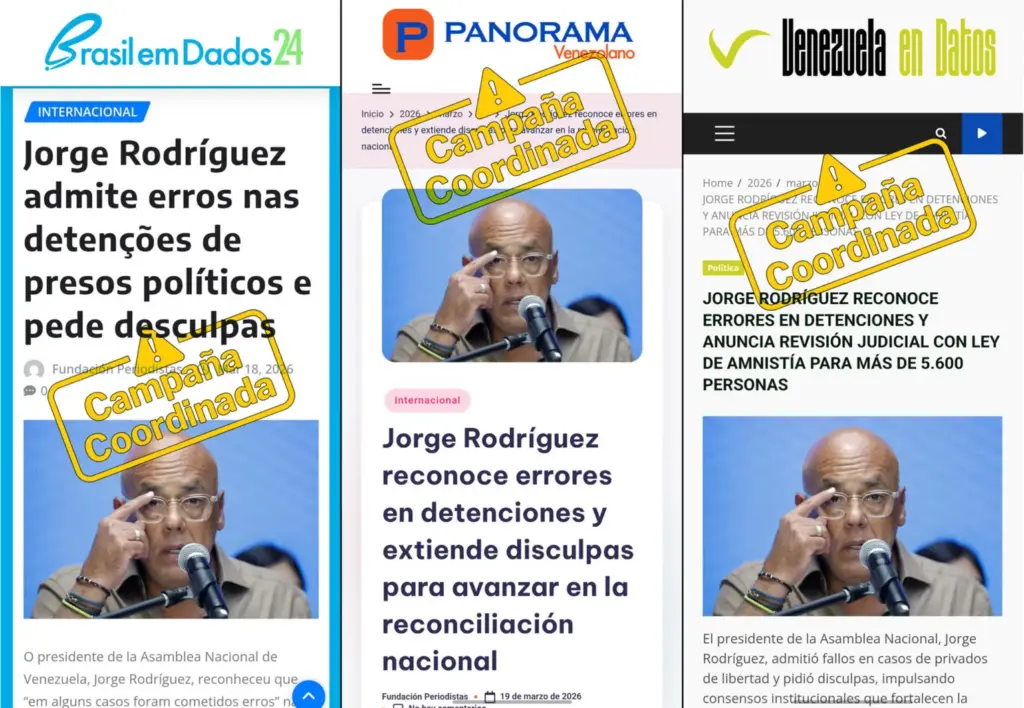
The analysis also revealed another pattern: the same article often appeared across multiple sites with different headlines and slight rewrites tailored to each country, but with nearly identical core narratives. It is a form of serial production, where one base story is rewritten and redistributed to simulate independent local coverage.
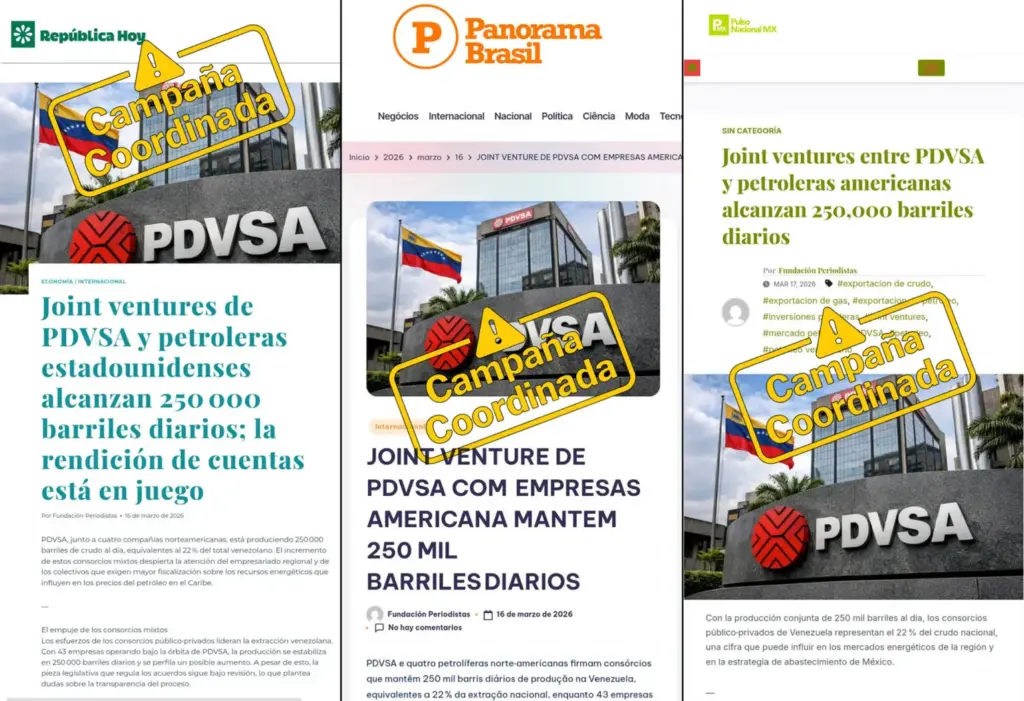
One example is coverage of joint ventures between PDVSA and US oil companies. Articles published on March 16–17 across republicahoy.do, pulsonacional.mx, and panoramabrasil.info repeat identical figures (250,000 barrels per day, 22% of national output) while adapting their framing. The Dominican version adds references to Caribbean fuel prices. The Mexican version mentions the Dos Bocas refinery and the Energy Ministry. The Brazilian version refers to the Palácio do Planalto and investment opportunities for Brazil.
The texts share repeated transitional phrases—“in this context,” “on the other hand,” “diante deste cenário”—and identical section structures. The Brazilian version also contains errors suggesting automated translation, such as “empresas americana” instead of “americanas” and leaving “barriles” untranslated.
Although headlines and wording vary, these articles share one constant: they use exactly the same featured images. By comparing images across all 11,391 articles, the tool identified hundreds of such clusters. Contents largely consist of one base story, adapted and republished across multiple sites with the same photo.
This is the first time Cazadores de Fake News has documented evidence suggesting the use of automation or generative AI to sustain an influence operation of this scale targeting Venezuelan audiences. Producing more than 11,000 articles in one month, localized by country and language, would have been unfeasible for a small team of human writers.
The websites have so far attracted little traffic. But the infrastructure is active, content continues to be published, and the material already looks credible enough to be mistaken for real journalism.
The trail leads to QSocial
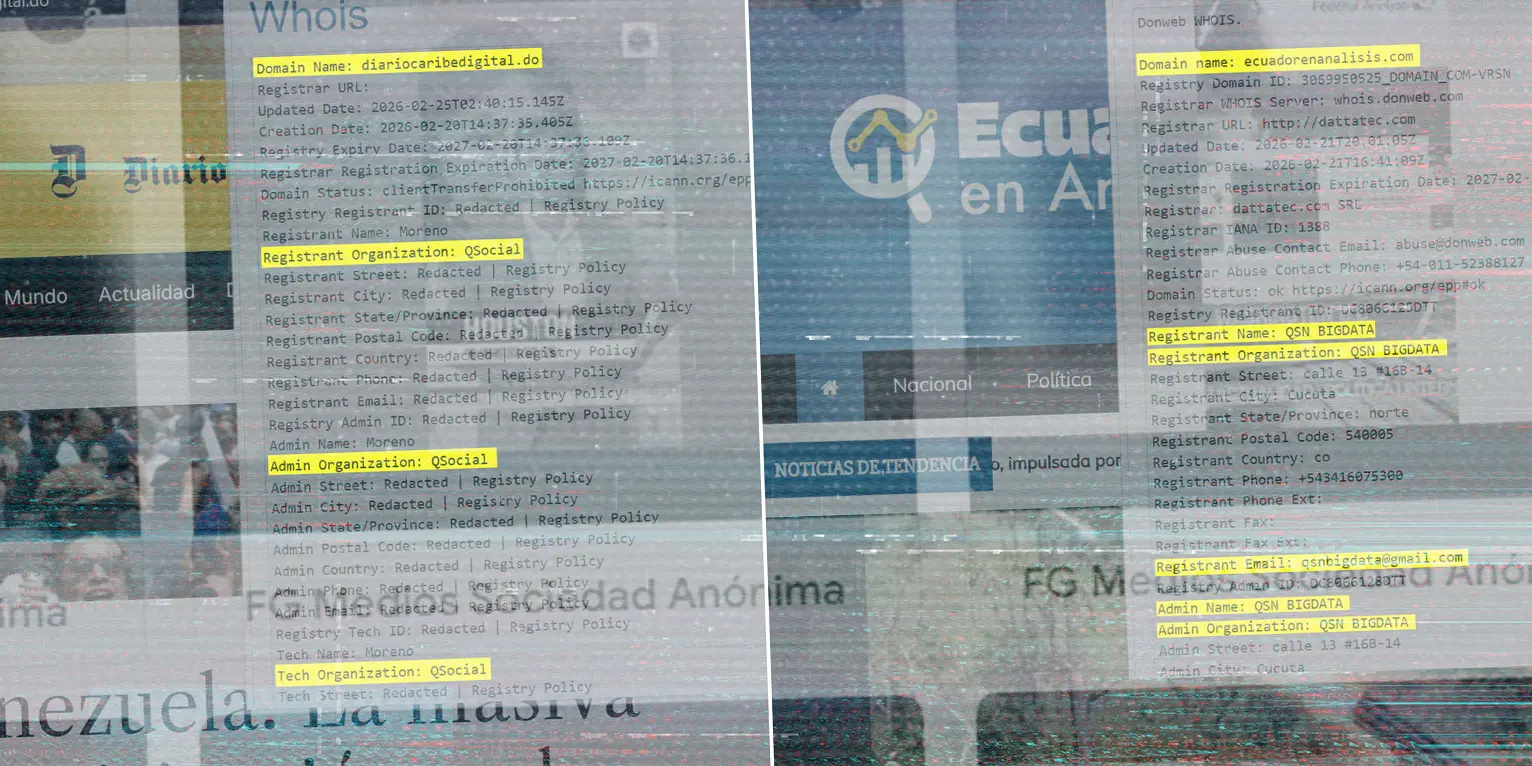
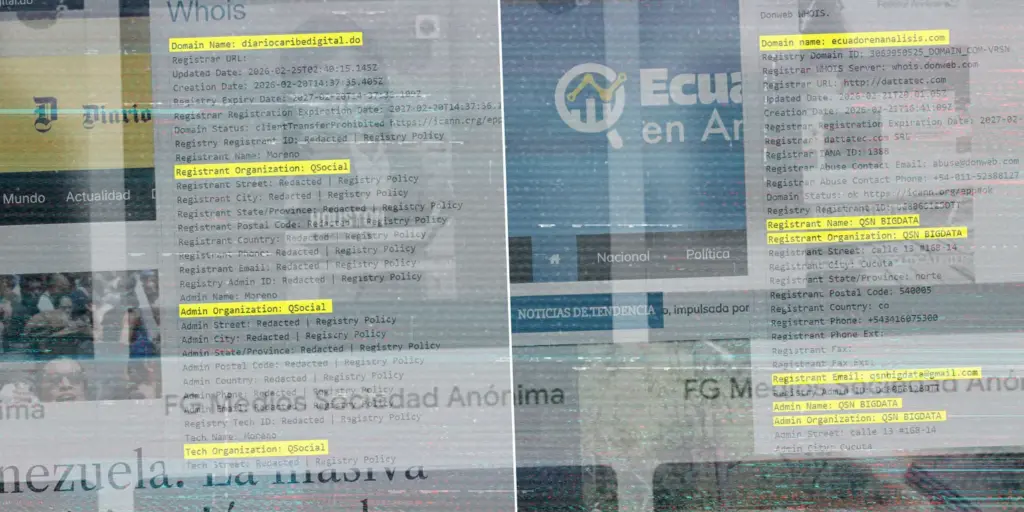
Despite the scale of the operation (30 websites, three social media platforms, and thousands of articles) those who registered the domains left traces. At least five domains lacked privacy protection, exposing registrant names and emails.
Three “.com” domains—brasilemdados24.com, ecuadorenanalisis.com, and panamaestrategico.com—list “QSN Big Data” as the registrant, linked to the email qsnbigdata@gmail.com.
Two Dominican domains—diariocaribedigital.do and republicahoy.do—were registered on February 20 at the exact same second. Their records list “QSocial” as the registrant. These are different names pointing to the same corporate ecosystem.
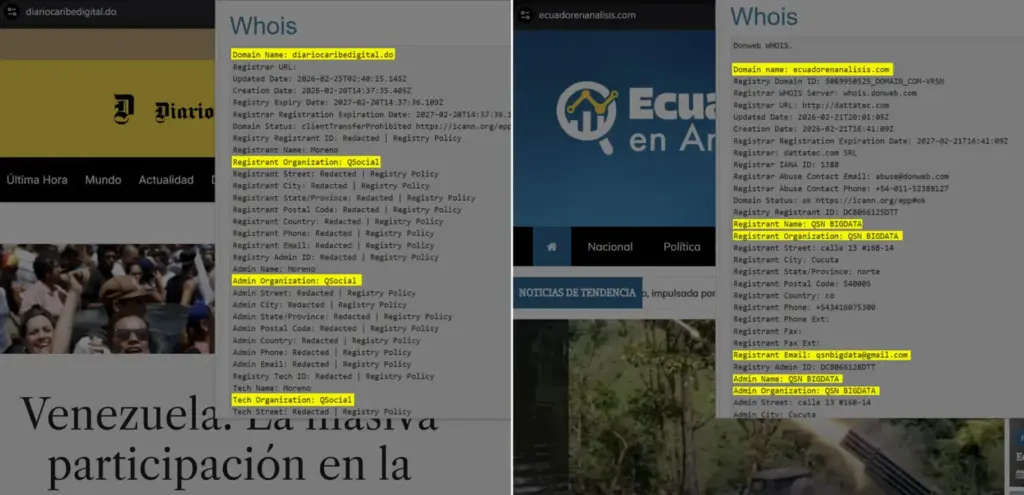
QSN Big Data and QSocial are names used by the same Argentine political communications firm, which has also operated as QSocialNow. According to a March 23 investigation by La Nación, the company—led by former Chubut governor Martín Buzzi—produced the fake newscast videos. The outlet reported that the videos were recorded at the company’s offices in Buenos Aires, where actors were recruited through a casting process.
The firm also has a documented history within Venezuela’s propaganda ecosystem. After the July 2024 presidential election, it produced a poll under the name QSocialNow backing a decision from Venezuela’s Supreme Tribunal to declare Nicolás Maduro the winner, despite widespread independent evidence of electoral fraud.
All domains in the network were registered through the same Argentine provider, within the same time frame, and using the same servers. However, this investigation could not determine whether QSocial itself entered the domain registration data or whether it was done by a third party.
Cazadores de Fake News and Argentine fact-checking outlet Chequeado contacted QSocial for comment. The company had not responded at the time of publication (March 24).
An unprecedented operation in Venezuela
Although QSocial director Martín Buzzi denied involvement to La Nación, the technical records documented in this investigation and the newspaper’s sources point to the same company. Who commissioned the operation and how it was financed remain unanswered questions.
It is also unclear whether the thousands of articles about Argentina, Mexico, Brazil, and other countries are merely camouflage for the pro-Rodríguez campaign or part of parallel influence operations using the same infrastructure.
There is no recent precedent in Venezuela for an influence operation of this scale deployed in such a short period.
Before Google, Meta, or the operators themselves took down most of the YouTube channels and 15 Instagram accounts, the propaganda videos had already surpassed 47.5 million views. At the time of publication, all Facebook accounts and the 30 websites remain active.
Journalism in Venezuela is practiced in a hostile environment for the press, with dozens of legal instruments designed to punish speech, especially the “against hate,” “against fascism,” and “against the blockade” laws. This content was produced by journalists who are in Venezuela and is being published taking into account the threats and limits that, as a result, have been imposed on the dissemination of information from within the country.