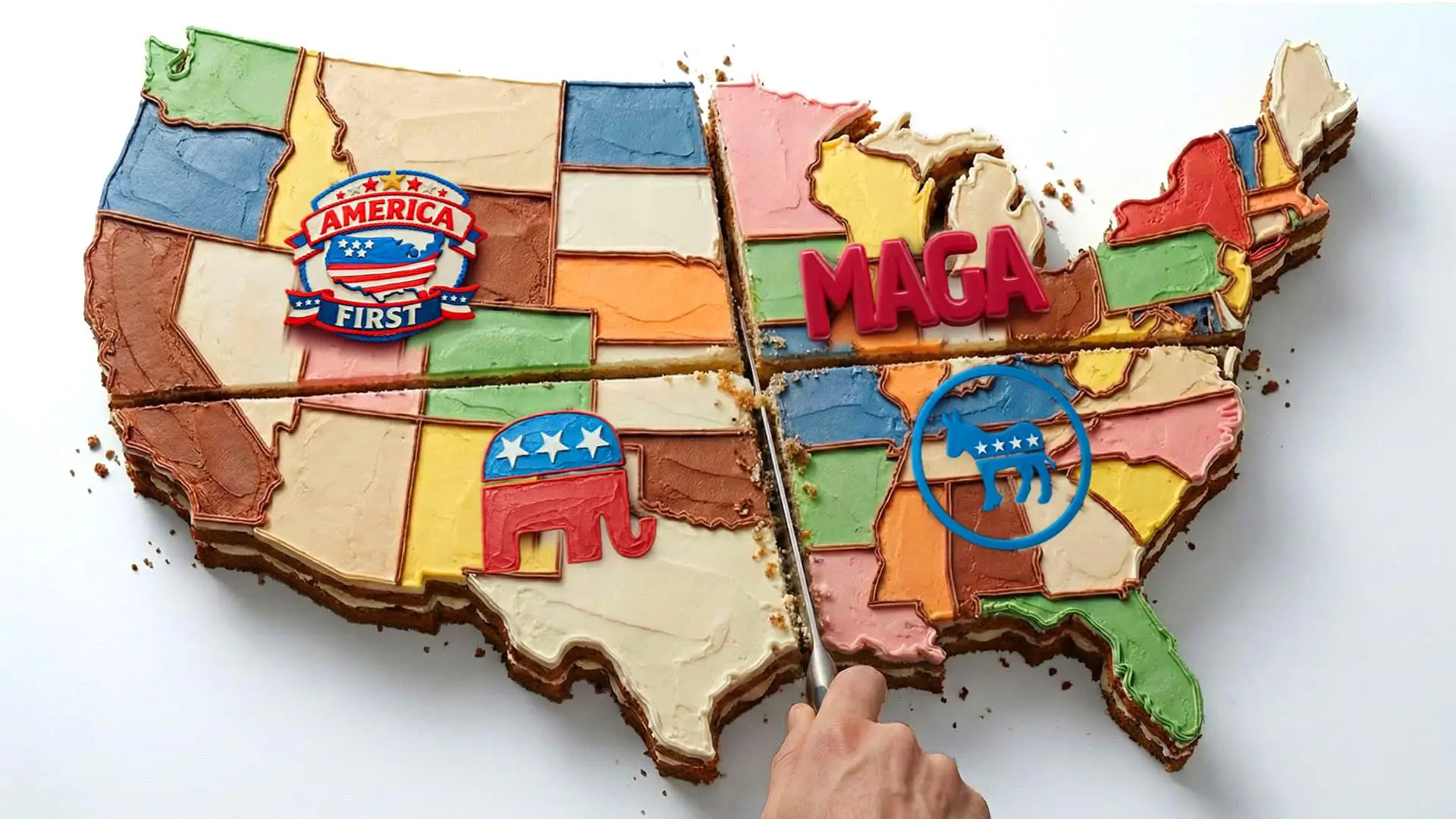
The pro-Maduro propaganda apparatus amplifies U.S. political statements and American media coverage that echo scripts circulated via the communications ministry’s internal messaging system
By: La Hora de Venezuela. Sixth and final installment of the “People or Script” series (“Pueblo o Libreto”).
The propaganda machine of Nicolás Maduro takes statements and articles from U.S. actors and repackages them as “evidence” of rifts and disagreements among his adversaries, seeking to exploit differences between media outlets, political parties, and ideological currents in the United States.
On September 1, at an international press conference convened in response to threats from the U.S. government, Nicolás Maduro declared: “The Miami mafia has seized political power in the White House and the State Department; they have imposed their extremist Miami-centric vision and have ‘Miamisized’ U.S. foreign policy toward all of Latin America and the Caribbean; because threatening Venezuela is threatening the entire continent.”
The phrase was not uttered in isolation: it fit into a script that was already in circulation. Days earlier, several similar arguments had been sent in a document distributed through Siscom, the messaging system used by Venezuela’s Ministry of Popular Power for Communication and Information (Mippci) to disseminate manuals and talking points to networks of media outlets, allied websites, and digital activists, and to coordinate their large-scale amplification.
This statement fits with a script distributed through Siscom, the the messaging system used by Venezuela’s Ministry of People’s Power for Communication and Information (Mippci) to push manuals and “lines” to networks of media outlets, aligned portals, and digital militants—and to coordinate their large-scale amplification.
“The U.S. warmongering maneuver is driven by extremist sectors in South Florida, representing less than 10% of the U.S. population, who seek to impose their agenda on the entire country, ignoring the majorities who oppose wars and want the government to focus on internal problems,” says one paragraph of the guiding document for the campaign “Venezuela Is Not a Threat; Venezuela Is Hope,” in a framing that pits an “extremist” American minority against a supposed majority, emphasizing an internal political fracture.
This investigation is the sixth and final installment of the “Pueblo o Libreto” series. After documenting the push behind coordinated campaigns on TV and social media—and the actors, tactics, and propaganda lines disseminated—this piece presents, for the first time, pages from the scripts in which those lines had been laid out.
On that basis, legitimate critiques that emerged in the United States—voiced with no coordination whatsoever with strategists from the Maduro administration—were turned into expressions of support for ideas already laid out in documents the Mippci had circulated through Siscom, and were then amplified across Venezuela’s entire pro-government ecosystem.
Recycling statements from Democratic voices
La Hora de Venezuela obtained access to several campaign-planning playbooks for government propaganda distributed through Siscom between March and September 2025. The material shows how, from the Mippci, “lines” are designed and distributed for coordinated dissemination through different amplification networks, including nearly 40,000 users participating in around 600 Siscom groups.
These documents contain dozens of narrative lines. Some match scripts already analyzed in earlier installments of the “Pueblo o Libreto” series. Others, however, seek to intervene in public conversation about the United States: to pit what the playbooks call the “Miami lobby” against currents such as America First and MAGA; to push U.S. isolationism; and to frame any military escalation against Venezuela as a pointless cost compared with the United States’ domestic problems.
On December 3, 2025, Democratic Representative Jim McGovern announced that he would introduce—together with Representatives Thomas Massie and Joaquín Castro—a new resolution under the War Powers Resolution to force a vote in Congress and halt what he described as the Trump administration’s “crazy escalations” against Venezuela. “No one, except the president and his crazy billionaire backers, want this war,” McGovern said.
Hours later, Madelein García, a journalist at Telesur—the international propaganda outlet dependent on Venezuela’s Mippci—quoted and translated McGovern’s post into Spanish in a publication that surpassed 10,000 views on X.
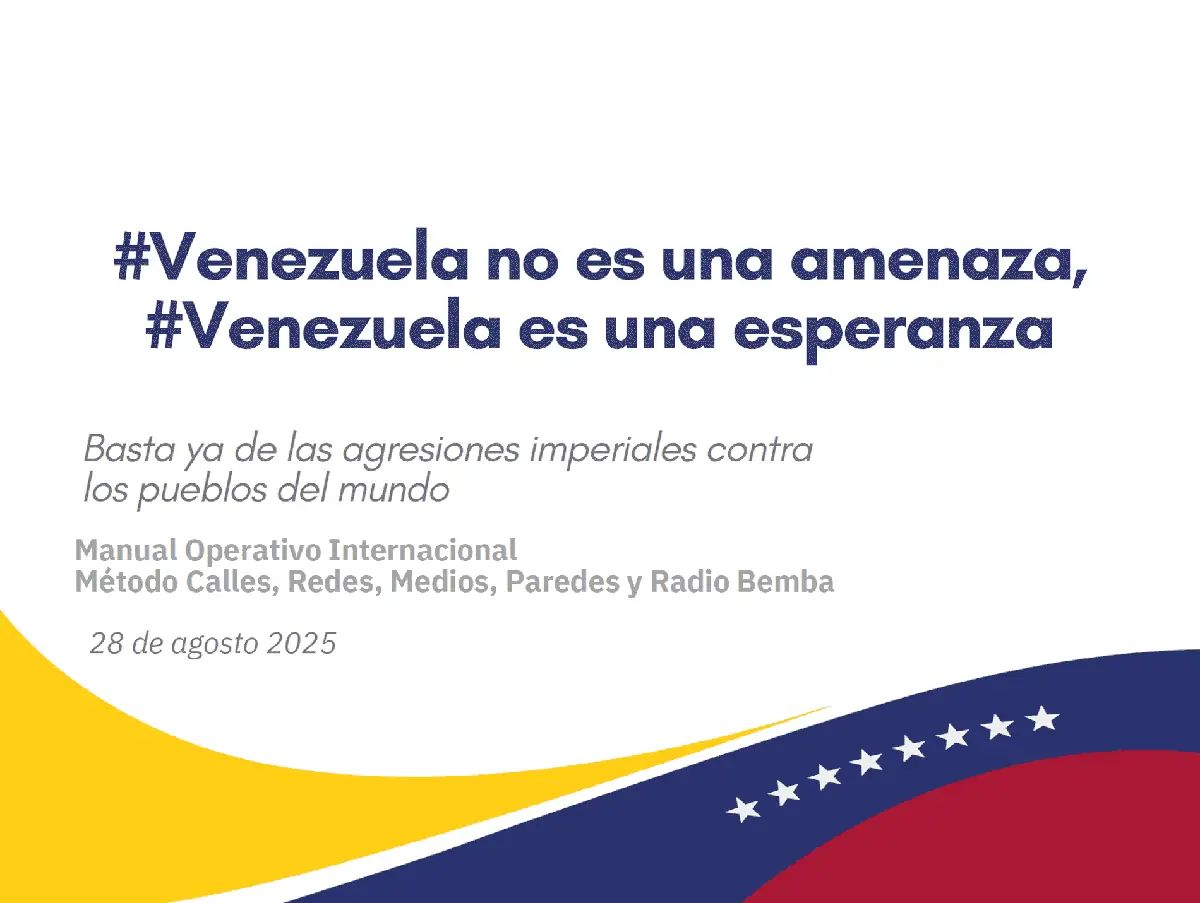
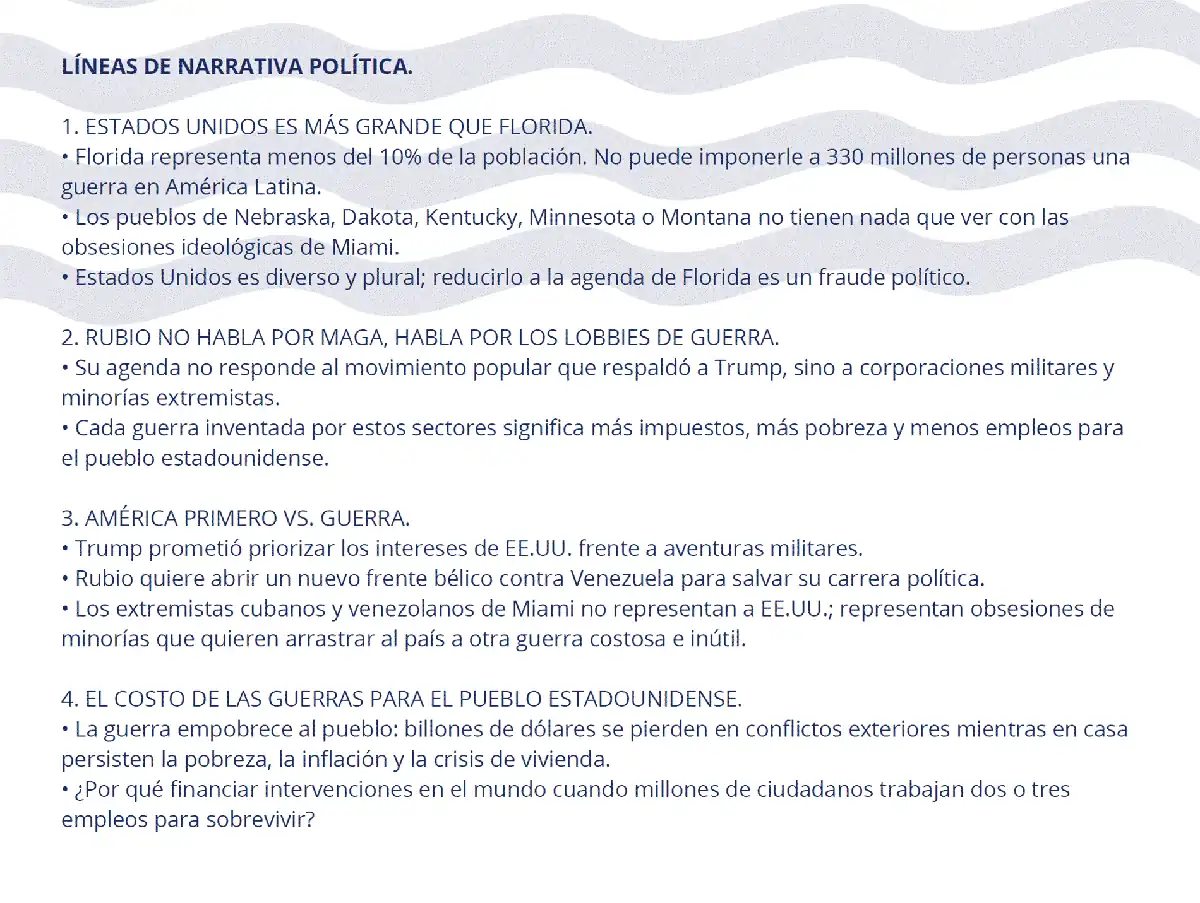
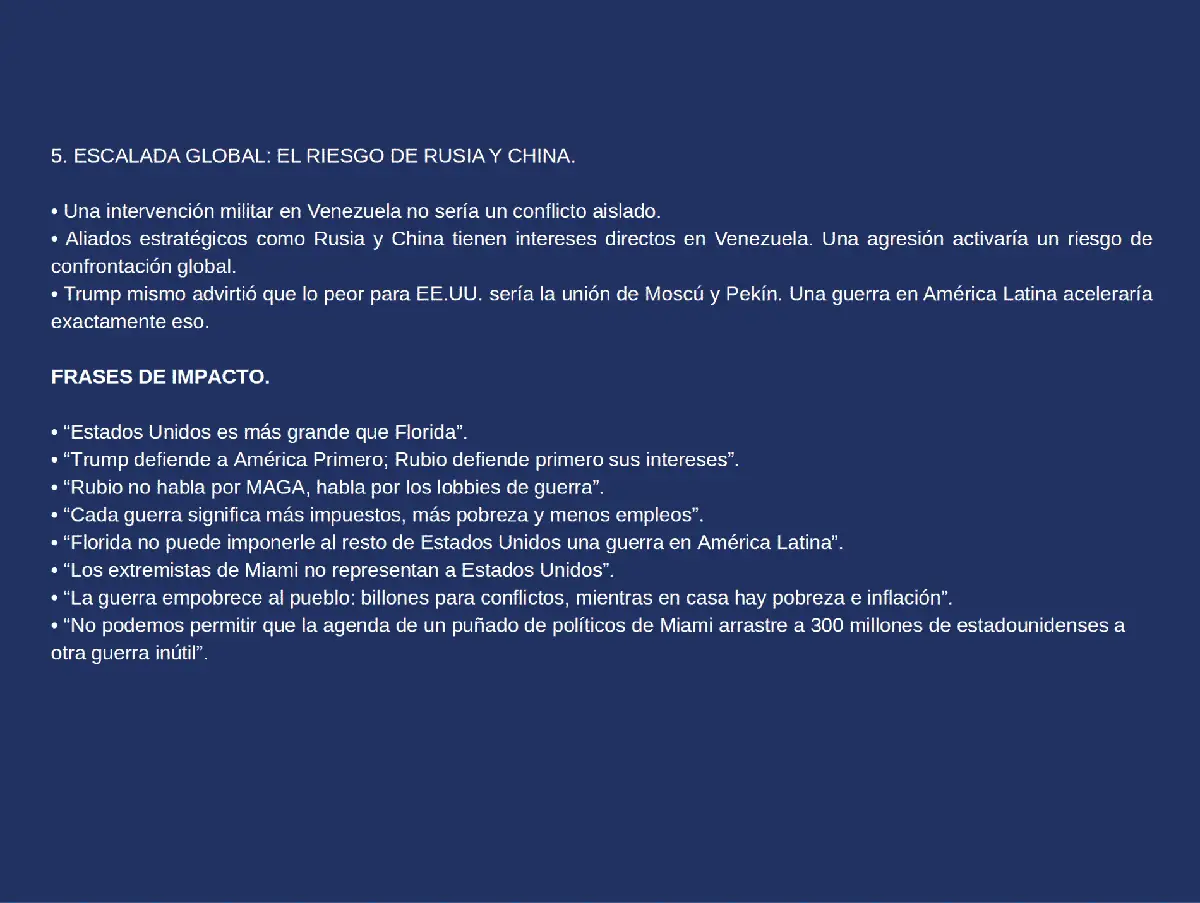
In broad terms, McGovern’s statement echoed talking points included in an operational manual formatted as a slide deck circulated months earlier through Siscom, on August 29, by Johannyl Rodríguez, Venezuela’s Vice Minister of Communication and Information. On page 7 of that playbook, for example, appear phrases such as “Rubio doesn’t speak for MAGA; he speaks for the war lobbies” and “His agenda does not reflect the popular movement that backed Trump, but rather military corporations and extremist minorities.”
García’s citation of McGovern served as external validation for narratives the Maduro administration is trying to position. There was no need for sympathetic journalists, outlets, or communicators to claim that Washington was divided over Venezuela: it was enough to amplify a Democratic lawmaker speaking from within the U.S. political system, making the framing sound less like official propaganda.
Days earlier, on November 29, 2025, Democratic Senator Chuck Schumer had also questioned whether U.S. policy toward Venezuela aligned with the America First principle—arguing that it implied unnecessary spending of resources and misplaced priorities at home.
“Americans are tired of endless foreign wars that cost the lives of countless American servicemembers and drain precious resources. This is not an America First policy,” Schumer wrote on X.
Schumer’s argument also resonated with ideas already laid out in the August 29 slide deck: the rupture between America First and war, and the cost of escalation for ordinary citizens. Among the playbook lines sent by the Mippci official stand out: “Trump promised to prioritize U.S. interests over military adventures,” “War impoverishes the people: trillions of dollars are lost in overseas conflicts while at home poverty, inflation, and the housing crisis persist,” and “Why finance interventions around the world when millions of citizens work two or three jobs to survive?”
Venezuela News—an “unofficial” pro-Maduro propaganda mouthpiece and a frequent amplifier of disinformation—summarized Schumer’s statements as further proof that figures in Democratic leadership question the coherence and legitimacy of an escalation against Venezuela. The coverage used the same technique: reframing an internal U.S. critique as confirmation of narratives that had already been defined in playbooks distributed through Siscom.
On September 2, Juan González—former Senior Director for the Western Hemisphere at the National Security Council during the Biden administration—questioned on X the logic of the military deployment in the Caribbean: “So the USG is using spurious info to justify a terrorist designation & then spending at least $7M/day for an aircraft carrier group to kill 11 traffickers on a boat w max capacity for 3 tons?”
Within hours, the Venezuelan News Agency (AVN)—attached to the Mippci—turned it into a headline (“Former Biden adviser denounces false information and multi-million-dollar waste”). González’s comment was also picked up by Venezuela News and Globovisión, two other “unofficial” pro-government propaganda amplifiers.
Once again, the framing was perfect for amplifying the playbooks’ narratives—without Maduro’s propaganda apparatus having to manufacture the message.
Sowing discord between Marco Rubio and MAGA
Alongside narratives about America First and the unnecessary spending of U.S. public resources, the playbooks distributed through Siscom also outline another divisive line: presenting U.S. policy toward Venezuela as the product of an internal rupture in which a minority—associated with Secretary of State Marco Rubio and several Cuban-American Florida politicians—would drag the country into an escalation unwanted by the rest of the population.
These directives aim to intervene in U.S. public conversation from within, attempting to sow discord by amplifying pre-existing tensions between the Make America Great Again (MAGA) movement and parts of Washington’s political apparatus.
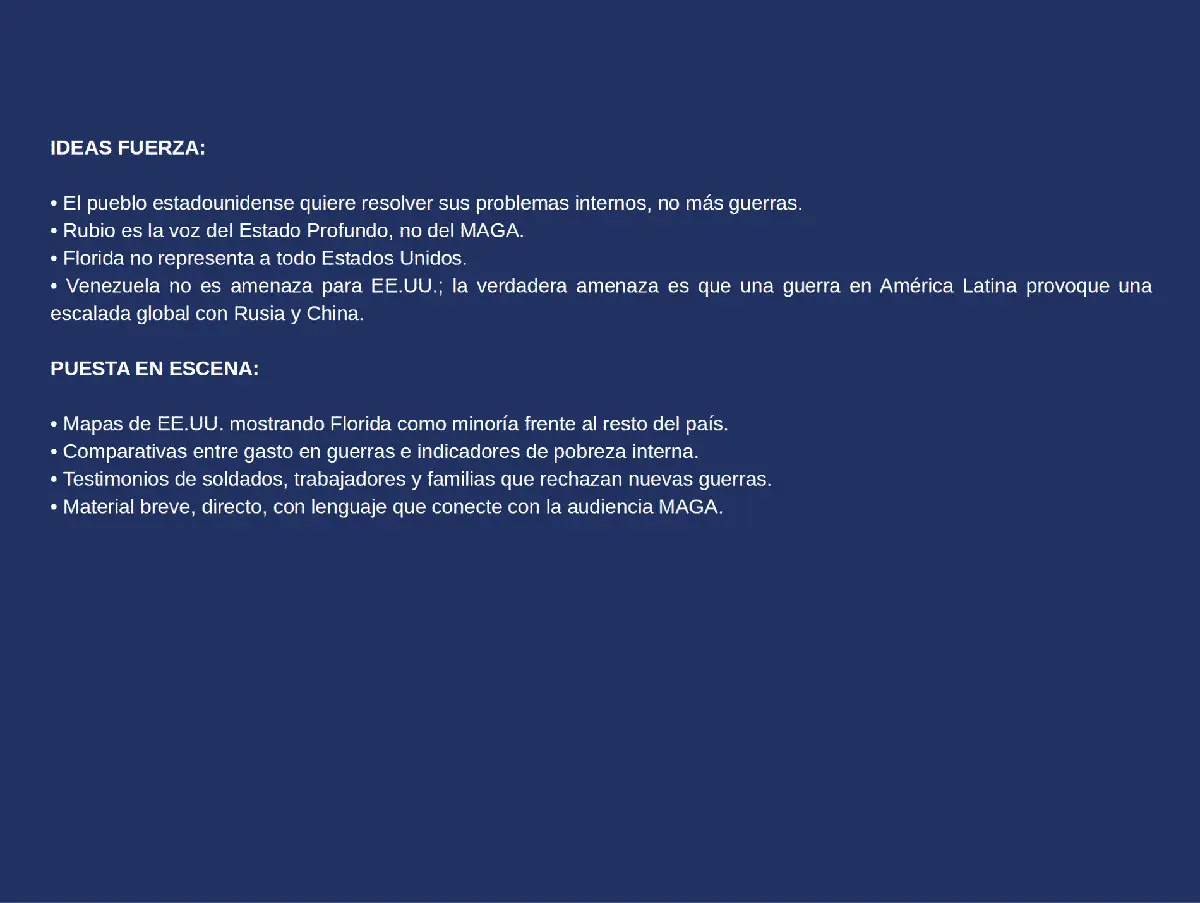
The same playbook sent through Siscom on August 29, for example, lays out staging and formats for content that includes “brief, direct material that connects with the MAGA audience.” In another section it lists “impact phrases,” such as: “Rubio doesn’t speak for MAGA; he speaks for the war lobbies,” “Trump defends America First; Rubio defends his interests first,” and “Florida cannot impose a war in Latin America on the rest of the United States.”
A concrete example of content designed to deepen these differences is a video published on November 15, 2025 on the X account of Extra News Mundo, another “unofficial” Venezuelan propaganda source. In the video—published alongside an opinion article signed by an anonymous author, “Unleash Dracarys”—the narrator summarizes an interview with former congresswoman María Elvira Salazar conducted by Univisión and highlights the reaction of Laura Loomer, a right-wing activist and influencer aligned with Trump.
“Unleash Dracarys” is the pseudonym used by Dayra Rivas, Director of Digital Media at the Mippci, to take part in a covert government information operation that the ministry has been pushing on X since early 2025. The voice-over in the video is Rivas’s.
The video script follows—almost point by point—the “MAGA vs. Florida” contrast recommended by the playbook distributed through Siscom. It claims that a group of Cuban-American Florida politicians is trying to impose a war on Trump and ties the narrative to an anti-interventionist frame, asserting that the main drug problem in the United States is fentanyl.
The covert propaganda video seeks to fuel friction between interventionist Cuban-American politicians (represented by Salazar) and the isolationist factions aligned with MAGA and America First (represented by Loomer).
Amplifying “useful” New York Times articles
On December 4, 2025, The New York Times published a photo essay about life in Caracas in which, despite the U.S. military deployment in the Caribbean, the city appears to continue its routine.
The article—which opens with a video of a group of Caracas residents dancing in a nightlife venue—moves through scenes of concerts, baseball, and early Christmas celebrations in a country that seems calm. At the same time, it warns that surveillance by Venezuelan security forces has dampened open expression of dissent and closes with a doubt: whether that tranquility can be fully believed.
A shortened version of the piece, published on The New York Times Instagram account, received more than 1,000 comments, at least half of which were negative or rejecting. The carousel opened with the same video of Venezuelans dancing, but omitted the doubt that anchored the original report’s ending.
Part of the backlash stemmed from the Instagram framing: although everyday life continues in Caracas, the piece’s message appeared to foreground the festive and the routine—while pushing into the background the censorship, fear, persecution, and militarization that have deepened in Venezuela since the 2024 presidential election fraud was cemented. Moreover, that celebratory tone resonated with multiple reassuring propaganda pieces that began appearing more frequently in the pro-government ecosystem after the start of the Caribbean operation.
For example, since mid-November, at least five videos of Venezuelans dancing and celebrating were shared through Nicolás Maduro’s official Telegram channel under the same frame of normalcy and peace in the country. In one of them, Maduro danced and asked for “rumba” every day of the week. All of that content was amplified massively and in coordinated fashion by state media and networks of digital activists, in line with the “Street, Networks, Media, Walls, and Word-of-Mouth Radio” method attributed to Maduro himself, which lays out his overall propaganda strategy.
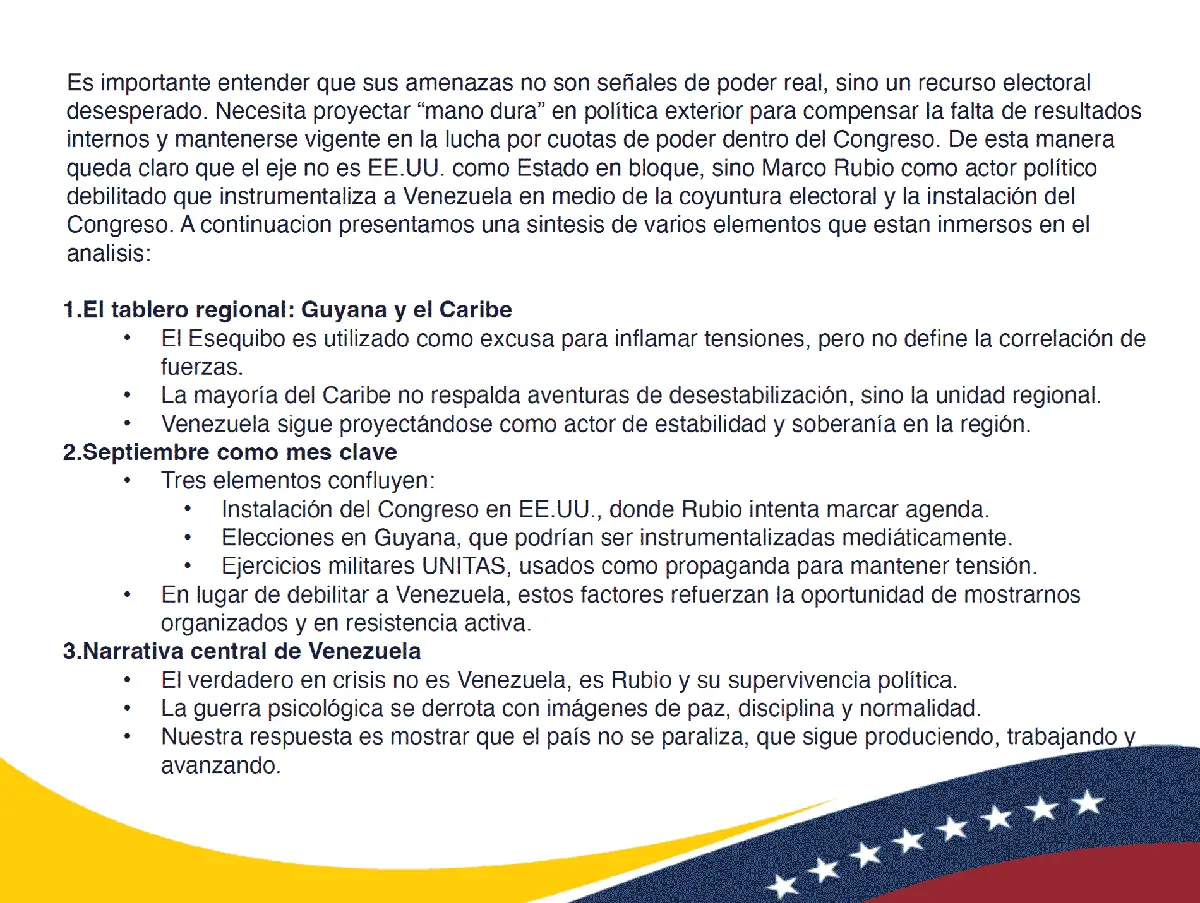
That same approach also appears laid out as an operational line in another playbook circulated through Siscom.
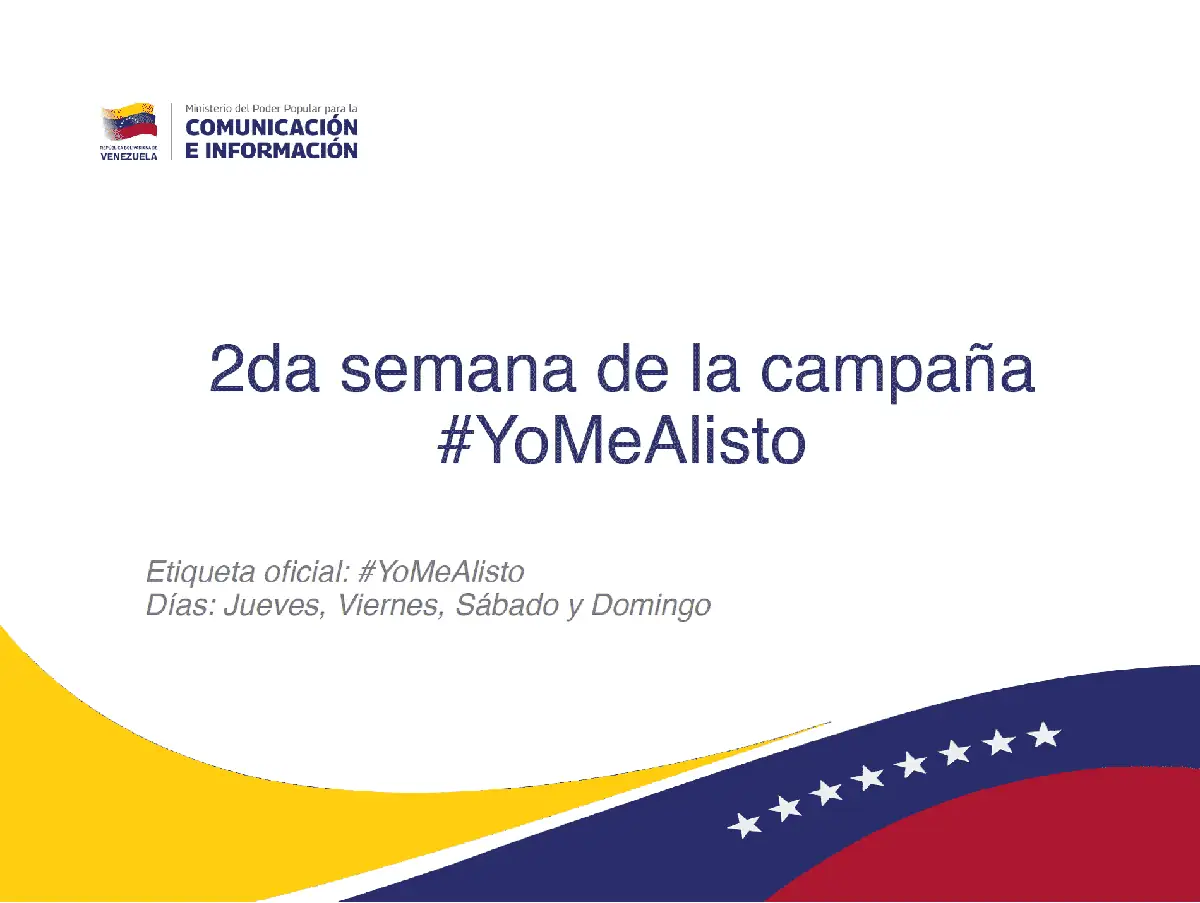
In a presentation sent on August 26, ahead of the launch of the #YoMeAlisto campaign, it explains: “Psychological warfare is defeated with images of peace, discipline, and normality” and “Our response is to show that the country does not come to a halt—that it keeps producing, working, and moving forward.”
Even more explicit was the exploitation of another New York Times article, published on November 26, 2025, which compiled criticism from former diplomats, experts, and opposition figures regarding claims attributed to María Corina Machado. The story warns that, amid the Trump administration’s military deployment in the Caribbean, some voices fear that claims are being exaggerated—or that false assertions are being circulated—to justify an intervention, and it references “debunked claims” on issues related to drug trafficking and security.
The report also lined up with propaganda lines included in pro-government playbooks in which the “war on drugs” is framed as a pretext to continue escalation and militarization in the Caribbean. In the playbook circulated on August 29, for example, one especially clear line appears: “The Cartel of the Suns is a media fabrication to justify aggression,” alongside other assertions that the United States uses that frame to push regime change and expand its presence in the region.
Screenshots of that report were quickly exploited by a network of propaganda video creators who coordinatedly amplify Venezuela News content across several platforms, as well as by the covert information operation deployed on X by the Mippci’s Directorate of Digital Media.
The campaign sought to reinforce a line already present in Siscom documents: discrediting María Corina Machado by portraying her as a disinformation source who would be pushing the United States toward an intervention.
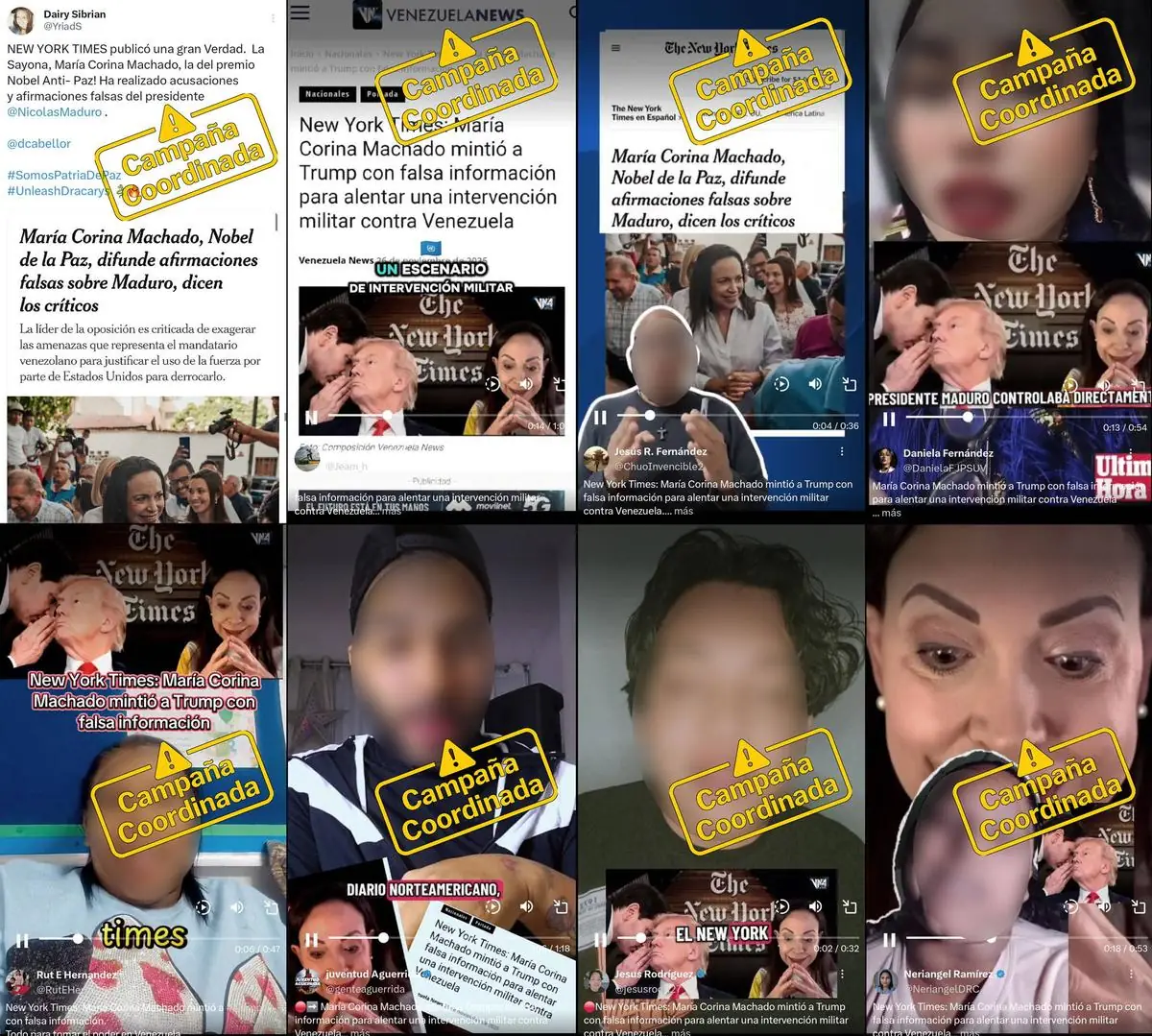
The New York Times report, however, did not incorporate a piece of Venezuelan context that is highly relevant to that reframing: the documented record of more than 80 hoaxes and disinformation incidents targeting Machado from Maduro’s communications apparatus between 2024 and 2025.
That absence made it easier for the story to be repurposed as support for a line already present in Siscom documents—accusing her of being a disinformation actor—despite the fact that at least one of the playbooks also includes additional disinformation lines against her, such as blaming her as the “sole and direct person responsible for human rights violations against Venezuelan migrants” or linking her to the financing of the Tren de Aragua.
***Journalism in Venezuela operates in a hostile environment for the press, with dozens of legal instruments designed to punish speech, such as the laws “against hate,” “against fascism,” and “against the blockade.” This content was produced by journalists who are in Venezuela and is being published with full awareness of the threats and constraints that, as a result, have been imposed on the dissemination of information from within the country.
Cazadores de Fake News investiga cada caso mediante la búsqueda y el hallazgo de evidencias forenses digitales en fuentes abiertas. En algunos casos, se usan datos no disponibles en fuentes abiertas con el objetivo de reorientar las investigaciones o recolectar más evidencias.
Ver metodología