X is blocked in Venezuela, yet accounts with no apparent institutional ties remain active there, promoting Maduro and attacking his opponents. A profile with a dragon avatar is the link between this information operation and Venezuela’s Ministry of Communication.
The social network X remains blocked for millions of Venezuelans. Anyone who wants to access the platform inside the country must use a VPN or be a customer of one of the few internet providers that have not yet restricted it. Although the censorship of X was announced as a temporary measure, as of November 2025 it is still in effect.
Despite the clampdown, X is still flooded with messages in favor of Nicolás Maduro. Hashtags, images, and propaganda videos—presented as expressions of the “popular outcry”—are published in a coordinated manner by pro-government accounts, in an unending sequence of digital propaganda campaigns. X is a strategically important space for Chavismo, where it continues to maintain a presence, at least in a non-institutional way.
“In Twitter (X) there’s an important war to fight. Abandoning this space means leaving free and open flanks for attack by our historic enemy. There is no retreat on X—there is struggle, battle, and victory! No more VPNs! #ChavistaYoTeSigo,” wrote an anonymous account in July whose avatar is the silhouette of a dragon surrounded by red flames—one of many profiles, apparently operated by government sympathizers, that have not stopped posting pro-Maduro content on the platform.
However, what looks like a group of citizens with no connection to Maduro’s government pushing digital propaganda is, in part, the product of an information operation promoted by Venezuela’s Ministry of Popular Power for Communication and Information (Mippci, Ministerio del Poder Popular para la Comunicación e Información). It is a choreography involving officials from the very ministry that censored the platform in the country.
The anonymous account with the dragon avatar is, precisely, a key link in that operation. There is concrete digital evidence that the anonymous account is connected to Dayra Rivas (Mippci’s Director of Digital Media) and other people tied to Escuela Influye, the training program for pro-government content creators run by officials from the same ministry.
For now, the effect of this operation is confined to the same bubble of pro-government X accounts that drive it, but that dynamic can inflate the operation’s apparent impact and lead international media—and the operation’s own promoters—to believe that Maduro has more support on X than he actually does.
A Dragon in a Propaganda Campaign
A significant number of Nicolás Maduro’s government accounts stopped posting on X around August 9, 2024, a day after the social network was blocked in Venezuela. That day, Mippci’s account pushed the hashtag #HastaProntoX (#SeeYouLaterX)—a kind of “official” farewell from the ministry to a social network it had used for years to promote hundreds of coordinated digital propaganda campaigns.
As of November 2025, the clampdown remains. Although most X accounts linked to the executive branch are inactive, hundreds of pro-government X profiles keep alive Maduro’s “peace” message in response to the US-initiated war against the cartels. They do so by standardizing their posts with specific hashtags and by publishing images and videos that support the Maduro administration’s position and reject Trump’s.
Among these profiles is an anonymous account with a dragon avatar that began drawing attention with provocative messages:
“The Venezuelan people love peace, but to preserve it they are prepared for war (…) we’re not afraid of any Yankee (…) whenever you want, we want,” it wrote in a September 22, 2025 post.
The message ended with a direct taunt to the US president: “Remember, @realDonaldTrump: #VenezuelaSeEscribeConVDeVietnam (Venezuela, spelled with a V—as in Vietnam).”
The nod to Vietnam draws on a core idea in Venezuelan military doctrine: a US attack on Venezuela would trigger a prolonged popular resistance because—according to the Chavista narrative—“the Venezuelan people are armed” and have closed ranks around Maduro to protect him. The hashtag, however, began as a reaction to a more casual prompt: a jab at the Bolivarian Militia that Donald Trump had posted hours earlier on his Truth Social account.
“TOP SECRET: We caught the Venezuelan Militia training. A very serious threat!” Trump wrote, mockingly, commenting on a viral video of a group of inexperienced Venezuelan militiawomen. Dressed in civilian clothes with red T-shirts and carrying rifles, the women moved to take cover behind a series of improvised barricades on a sports court, amid shouts and some laughter from onlookers.
But the hashtag pushed by the Venezuelan pro-government camp on September 22, though it seemed like a spontaneous outcry, was more of a choreography. Those driving it were not mainly ordinary X users, and what they posted was not a display of “popular” indignation.
The campaign involved hundreds of accounts belonging to United Socialist Party of Venezuela (PSUV, Partido Socialista Unido de Venezuela) activists, pro-government outlets that often present themselves as independent media, and content creators tied to several Chavista propaganda teams—a digital ecosystem that floods the internet with posts, memes, synthetic videos, patriotic slogans, and talking points that shift almost daily.
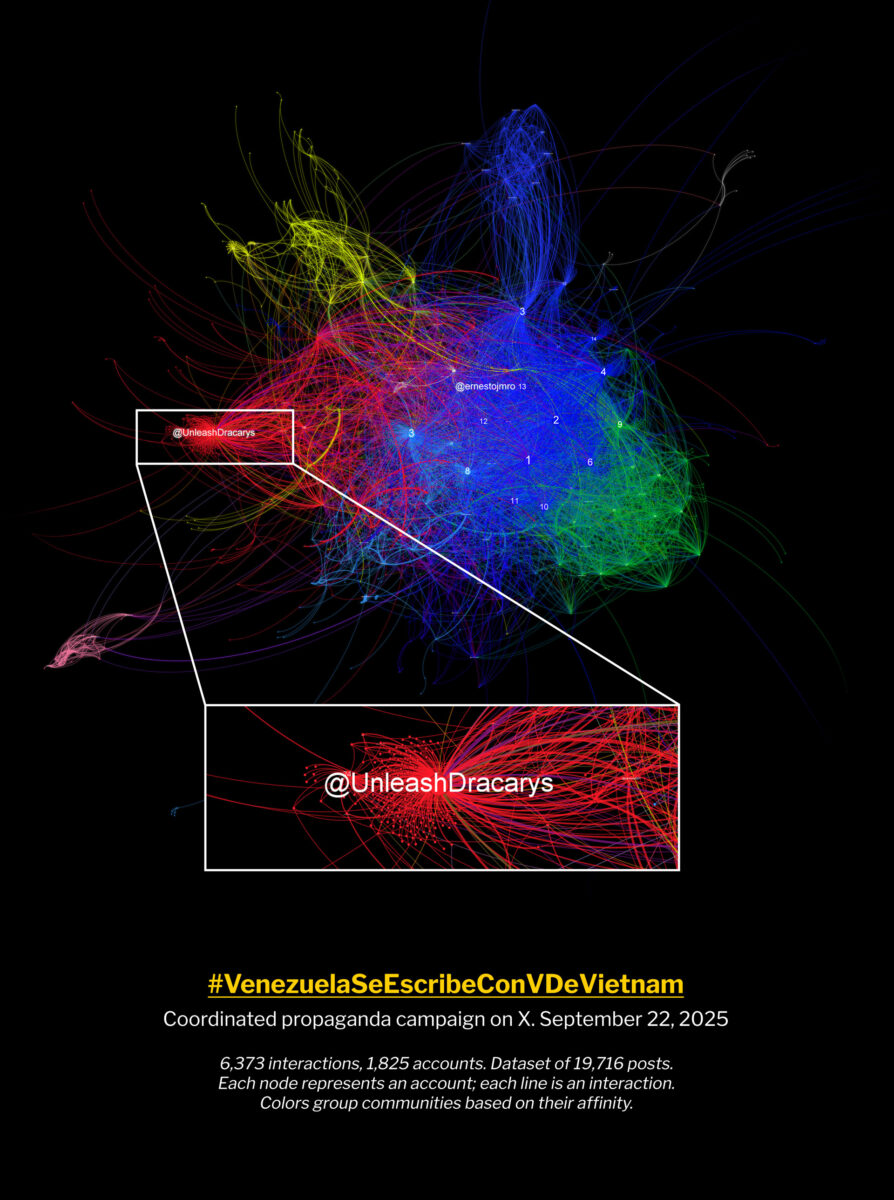
This is where the account with the dragon avatar, named Dracarys, comes into play. It was among the ten most influential in the September 22 campaign, but has taken part in many similar hashtags at least since March of this year.
Dracarys—“dragon fire” in High Valyrian, a fictional language from the TV series Game of Thrones—presents itself as a “research team” and consistently uses, as its personal seal, a logo featuring the silhouette of a dragon ringed by red flames. It also signs its posts with the hashtag #UnleashDracarys (in English), which in practice serves both as a brand for posts by the accounts closest to it and as a symbolic “summons” to spur them to join the campaigns it promotes.
Most of the accounts in its community—highlighted in red in the network graph—are not fake. They belong to real, flesh-and-blood communicators or activists, many of them affiliated with a specific pro-government digital collective, part of the Chavista “communication guerrilla” that has spent years coordinating to spread pro-government propaganda on X.
Despite the campaign’s spam, the hashtag #VenezuelaSeEscribeConVDeVietnam remained confined to an echo chamber on X—made up mainly of its promoters and followers—without attracting significant attention from outside audiences.
In the September 22 campaign, there were also two other distinct groups of accounts exhibiting suspicious behavior.
One of them, made up of at least 80 bot-like accounts—likely automated—quoted en masse a Dracarys post against Donald Trump that featured a propaganda video titled “Case: Trump, the Global Mockery.” All accounts interacted with the post exactly at 9:35 p.m., adding random, nonsensical codes to the text, a sign of possible bot (automated) activity.
As of October 31, X had suspended all but one of the accounts in this group.

Another distinct network also helped amplify the same Dracarys post. It was composed of more than 75 inauthentic accounts spreading covert propaganda under fictitious identities—in other words, a troll network.
The Hashtag Cauldron
In its posts, Dracarys uses a highly emotional, disparaging tone, with audiovisual pieces that incorporate AI-generated or AI-manipulated elements that at times dehumanize opponents of Maduro’s government. Its community mirrors these dynamics: it joins hashtag campaigns and circulates texts, memes, and images featuring the dragon logo and the #UnleashDracarys tag.
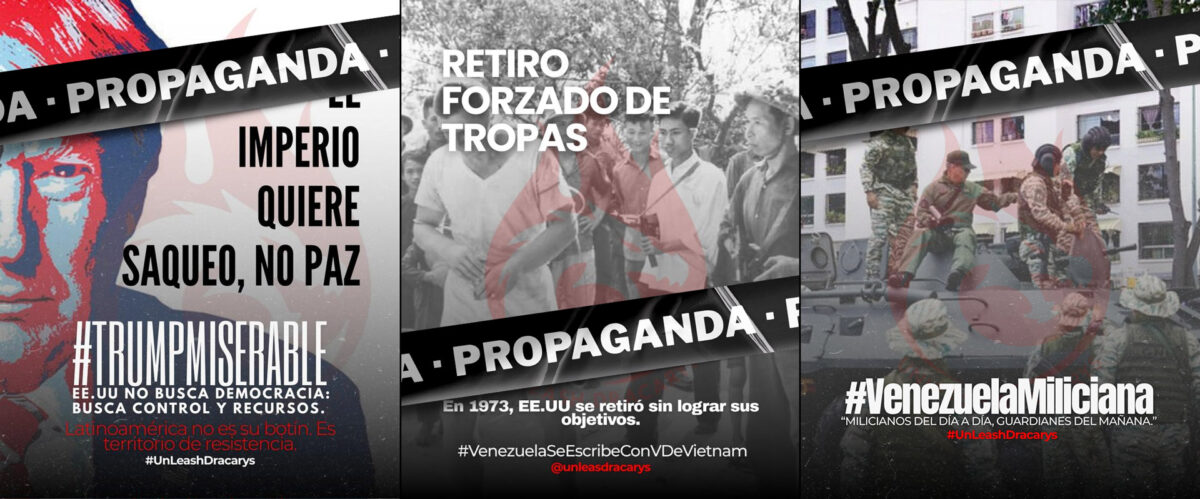
Dracarys took part, in an “unofficial” capacity, in promoting pro-government propaganda hashtags against Donald Trump, Marco Rubio, Pam Bondi and Argentina’s president, Javier Milei, among others. There is evidence that some of those hashtags—targeting María Corina Machado, Marco Rubio and El Salvador’s president, Nayib Bukele—were planned and promoted by Mippci officials, who sent manuals and content to thousands of users through their digital propaganda coordination tool, Siscom.
The Siscom app is available on the Play Store, now surpassing 50,000 downloads.
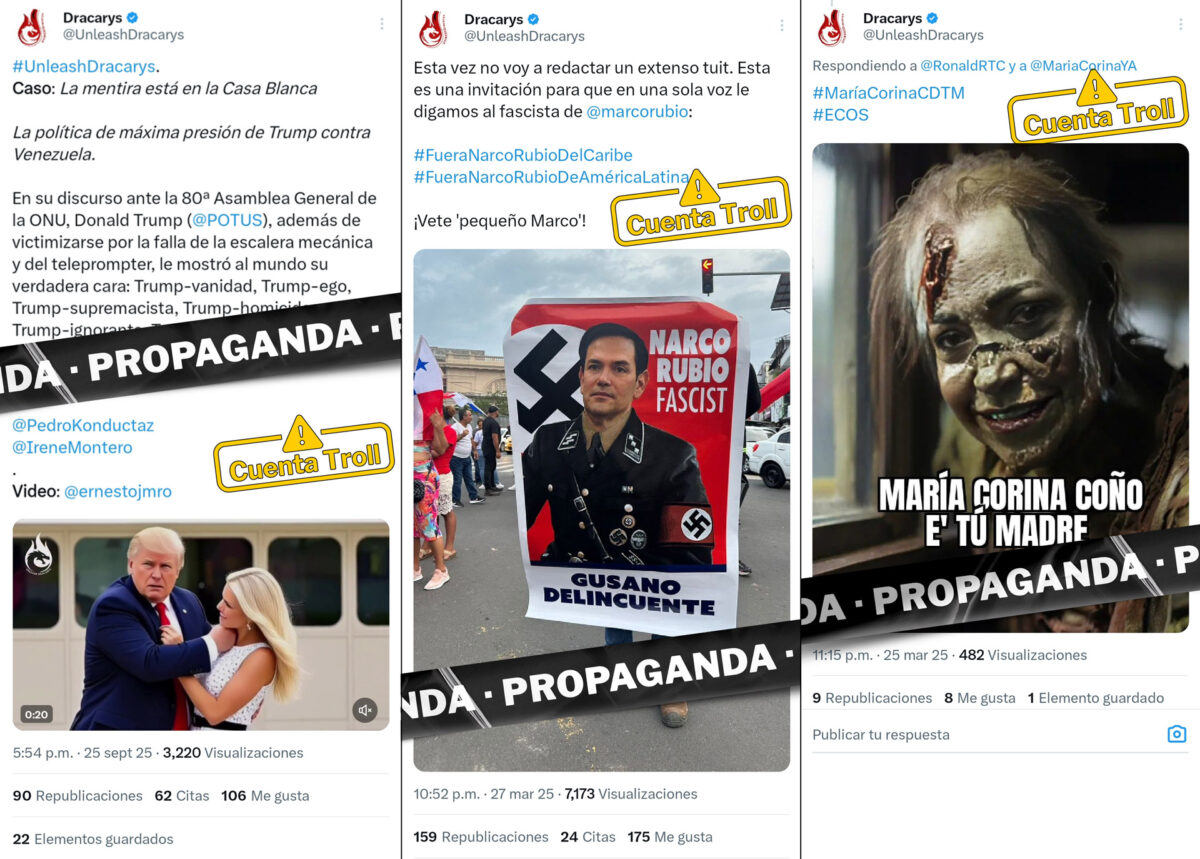
Beyond pushing propaganda hashtags, the anonymous account was also active in promoting several coordinated disinformation and stigmatization campaigns.
Dracarys quoted a generative-AI video depicting a fictitious Israeli youth crying amid ruins after Iranian missile strikes, and a hoax against Javier Milei accusing him of bestiality using as “evidence” an image also created with AI.
It also took part in the stigmatization campaign against Venezuelan activist Martha Lía Grajales, in which a misleading video was used to accuse her and her husband of being “undercover agents of the far right in Venezuela.” The same video had been sent the day before via Siscom by Johannyl Rodríguez, Venezuela’s Vice Minister for Communication and Information.
“Comrades, I’m sharing a video of Operation Grajales. Please, sweet dissemination,” Rodríguez wrote.
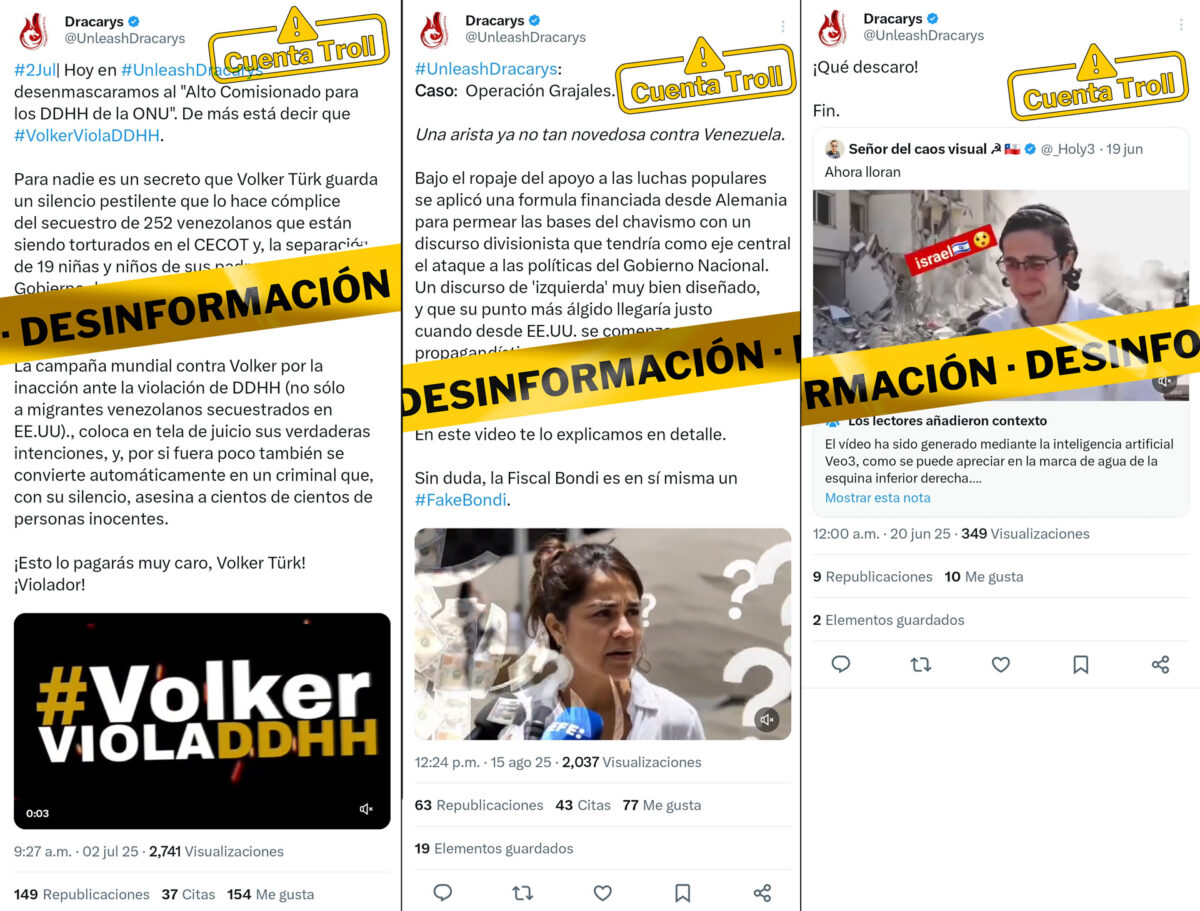
Likewise, Dracarys helped boost the hashtag #VolkerViolaDDHH (#VolkerViolatesHumanRights), a digital attack against Volker Türk, the United Nations High Commissioner for Human Rights, in which dehumanizing content targeting him was spread. Although the hashtag was presented as a “worldwide campaign” repudiating Türk, it was in fact another stigmatization effort promoted by the “communication guerrilla” accounts linked to Mippci.
Tracking the Dragon’s Footprints
Under its current identity, Dracarys has been pushing covert propaganda on X since February 2025. Its track record, however, links it to other aliases involved in digital attacks and disinformation campaigns in previous years.
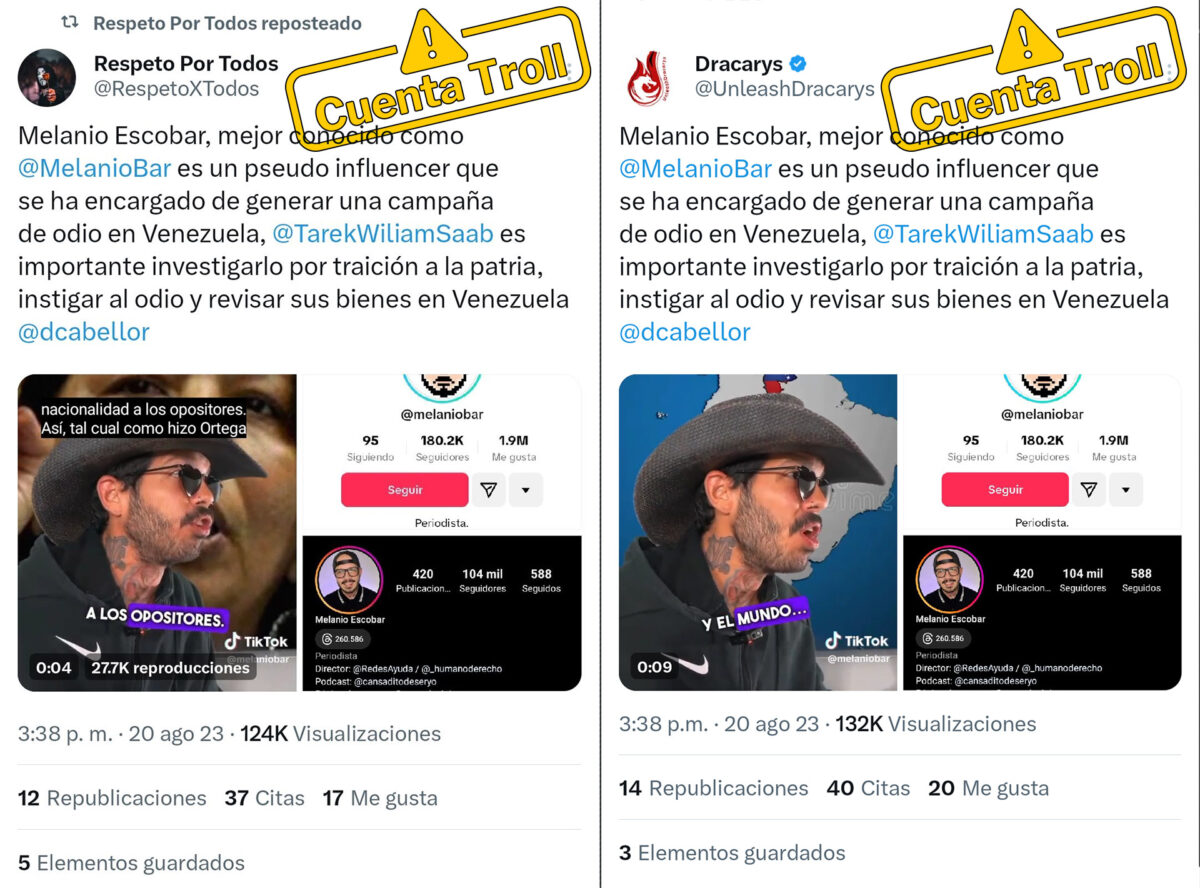
In August 2023, Venezuelan journalist in exile Melanio Escobar reported that an anonymous X profile called @RespetoXTodos had tried to criminalize his work by claiming he was behind “a hate campaign,” tagging Venezuela’s Attorney General, Tarek William Saab, in its accusations. Escobar was not the only X user to receive threats from the troll account, whose identity was then unknown.
An investigation published shortly thereafter concluded that @RespetoXTodos was being run by Ernesto Meléndez, an instructor at Escuela Influye (“Influence School”), a digital propaganda training program created by Mippci in response to an order given by Nicolás Maduro in 2021.
The account Dracarys uses today (@UnleashDracarys) is the same X profile previously known as @RespetoXTodos. Using the tool Tweethunter to investigate @UnleashDracarys and reviewing the source code of @RespetoXTodos posts archived on the Wayback Machine, it was possible to confirm that both aliases share X ID 1377855572884795392—a unique identifier that does not change even if the username does.
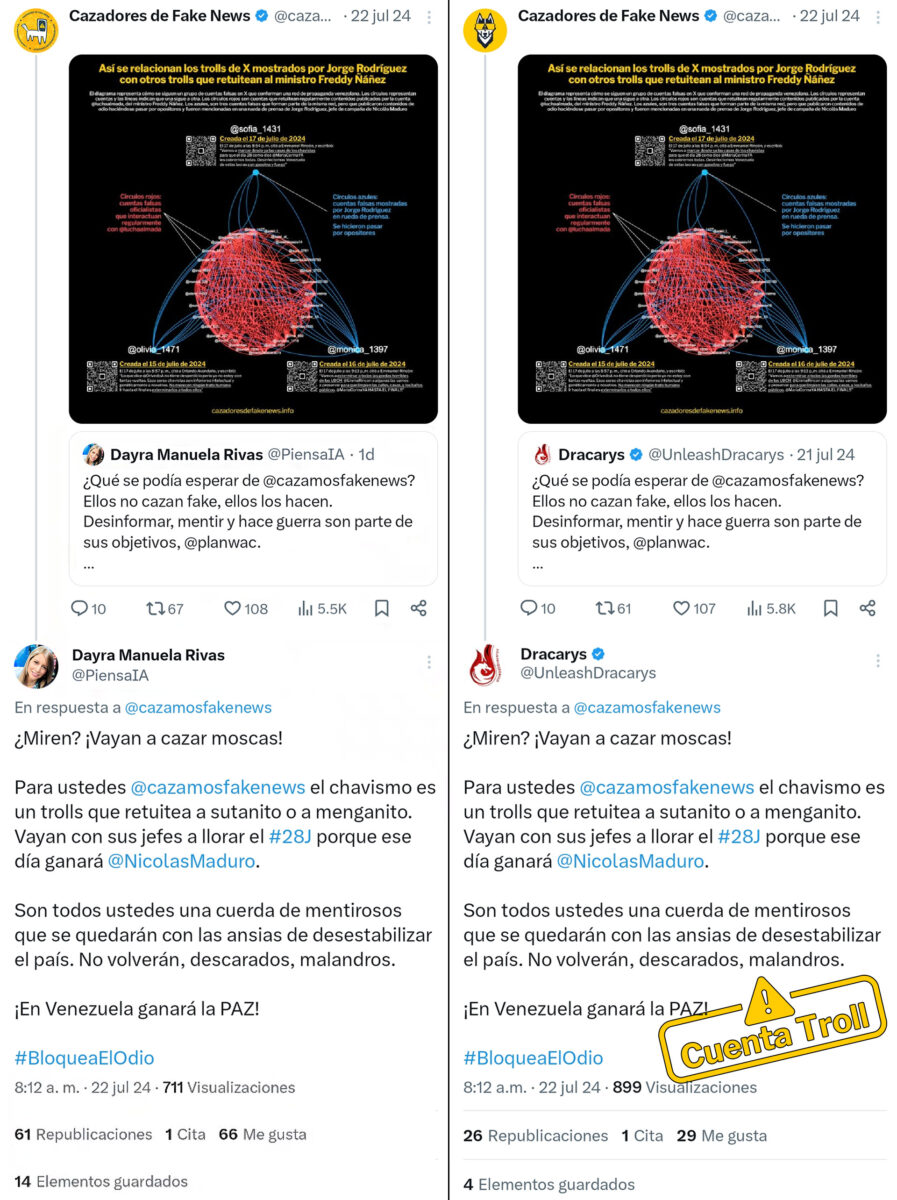
In 2024, the account stopped using @RespetoXTodos as its username and was renamed @PiensaIA, becoming publicly associated with Dayra Rivas, who since November 2023 had been appointed by the Minister of Communication and Information, Freddy Ñáñez, as the ministry’s Director General of Digital Communication, ad honorem.
Beyond her role at Mippci, Rivas has also publicly presented herself as an instructor at Escuela Influye. In a promotional video posted in November 2024 on the program’s Instagram account, she appears leading a training session alongside Ernesto Meléndez (to whom the operation of @RespetoXTodos was attributed) and other members.
On July 19, 2024, Jorge Rodríguez—president of the National Assembly, Nicolás Maduro’s campaign chief and former Minister of Communication—held a press conference where he presented screenshots of hate messages posted on X, attributing them to alleged opposition supporters. It was later demonstrated that the messages originated from a false-flag disinformation operation carried out by a network of troll accounts linked to Maduro’s campaign.
In response, Rivas used @PiensaIA to discredit the reports exposing this operation, publishing several posts that were in turn boosted by mass replies from the same troll network that had been reported.
By October 2025, all posts previously made by Rivas under the @PiensaIA profile appear under the authorship of Dracarys.
Maximum dissemination. Immediately, please.
On August 16, 2024, in a public Telegram group where dozens of members of various pro-government digital collectives and the so-called «communication guerrilla» coordinate, Dayra Rivas shared content with a clear instruction: “Maximum dissemination. Immediately, please,” attaching a video about the supposed “technical expert analysis” of tally sheets that the pro-government side presented as definitive proof of Nicolás Maduro’s claimed victory in the July 28 presidential election.
The staging showed a group of supposed “experts” wearing attire of the Venezuelan Supreme Court (TSJ, Tribunal Supremo de Justicia), the body that was supposed to independently audit the National Electoral Council (CNE, Consejo Nacional Electoral), Venezuela’s electoral authority.
An investigation published shortly thereafter revealed, however, that several of the supposed experts were officials close to one of the CNE’s board members, casting doubt on the appearance of impartiality of the assessment.
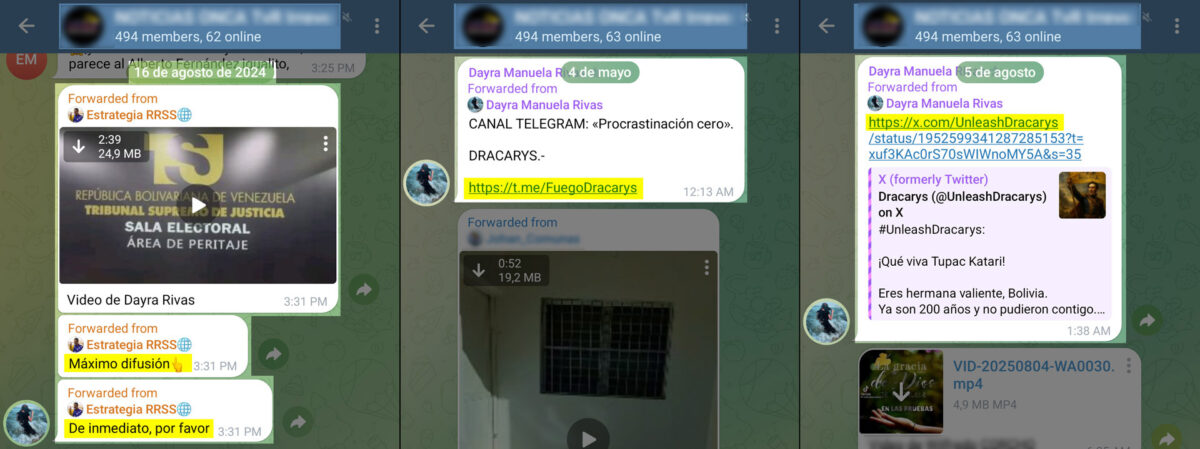
On another occasion, Rivas invited members of the group to join a new Telegram channel, @FuegoDracarys, whose avatar is a red dragon with the word “Dracarys” in uppercase.
“We are rifle and projectile,” reads the channel description.
There, Rivas shared links to 21 posts made by the Dracarys account on X between May 3 and August 5, 2025.
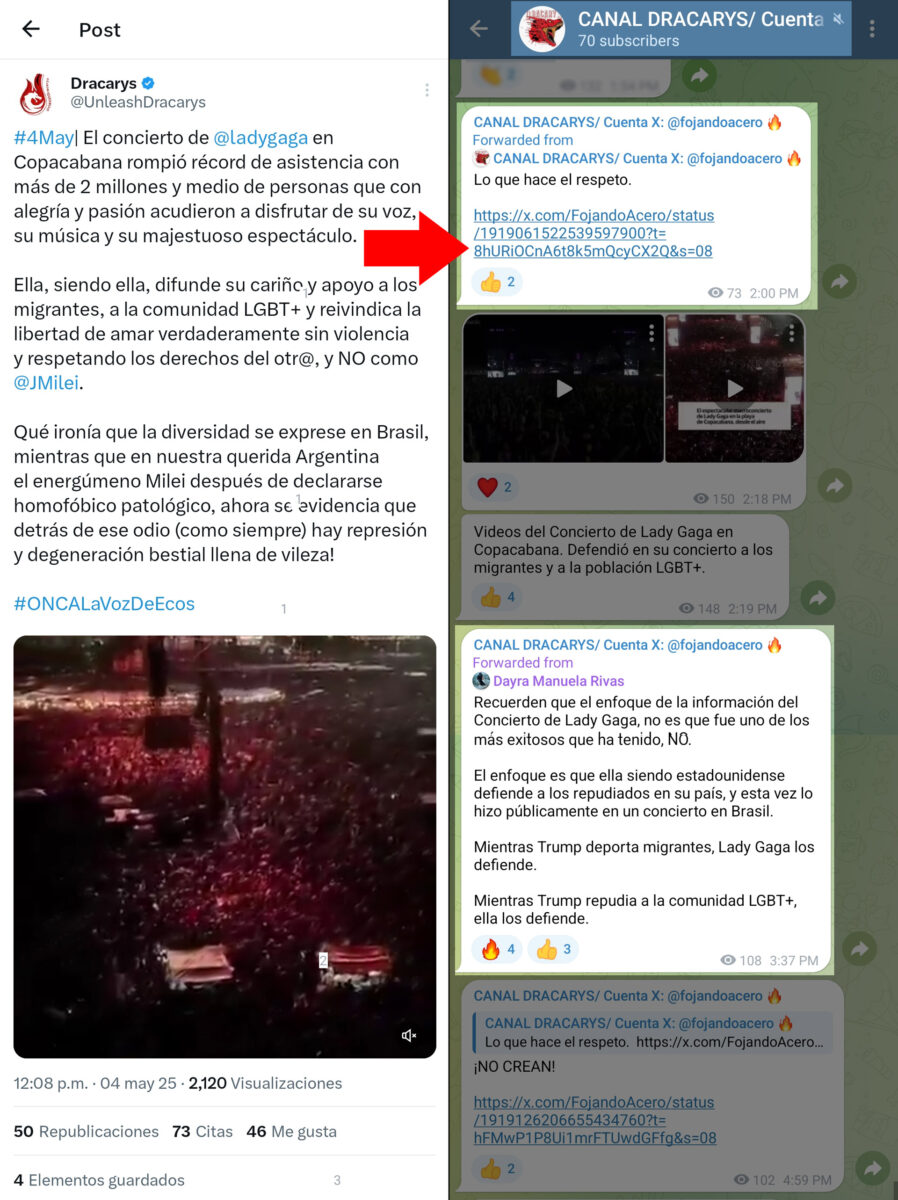
Through the channel, in May 2025, Rivas issued instructions on how to respond to a Dracarys post on X—which at that time used a different username, @FojandoAcero—about a Lady Gaga concert in Rio de Janeiro.
“Remember that the focus of the information about the Lady Gaga concert is not that it was one of the most successful she has had (…) it’s that she, being American, stands up for those shunned in her country, and this time she did it publicly at a concert in Brazil (…) While Trump deports migrants, Lady Gaga defends them. While Trump repudiates the LGBT+ community, she defends them,” reads Rivas’s message forwarded to the channel.
More recently, Dracarys has published content with more traces linking it to Rivas and the Digital Media Directorate at Mippci: the voice-over in several of its videos matches Rivas’s, as do certain photographs; the production of one piece was also attributed to Meléndez. The official Escuela Influye account has likewise shared content from the anonymous dragon-avatar account.
“Blessings (…) Happy Friday, comrade Dayra,” a user on X wrote in reply to Dracarys on September 19. “Dayra” is also a subanagram (partial anagram) of “Dracarys.”
When censorship and propaganda work hand in hand
For this investigation, Valentina Ballesta, Deputy Director of Research for the Americas at Amnesty International, stated that the blocking of X in Venezuela “represents an attack on freedom of expression in its various dimensions,” including the population’s right to receive information. Ballesta stressed that this restriction “is arbitrary,” lacks legitimate grounds, and that the fact that accounts linked to the government continue to use the platform for political purposes “makes the lack of legitimacy of this measure even more evident.”
Her assessment aligns with the observations of Andrés Azpúrua, director of VE Sin Filtro, the digital rights observatory of the Venezuelan NGO Conexión Segura y Libre, who argues that the Maduro government knows X remains an important space for public debate even after the blocking. Meanwhile, Venezuelans must use VPNs to evade censorship—limiting their ability to connect normally—something that affects the entire population, regardless of political affiliation.
This unequal control over access to X has also been denounced by human rights and free expression organizations. The Venezuelan free expression NGO Espacio Público highlights this paradox, which excludes a large part of the population while deepening informational inequality: “It is contradictory to arbitrarily block access for millions of users, thereby violating their right to freedom of expression and information, and at the same time devote resources and time to a privileged and unfair positioning effort funded with public money, which is also aimed at criminalizing critical sectors.”
This imbalance—in which the State imposes blocks on citizens while reserving full use of the platforms for its own campaigns—shows how censorship and propaganda do not cancel each other out, but instead reinforce one another. “Government structures have ended up using some of the same tools to circumvent their own blocking measures and participate in these campaigns,” Azpúrua noted.
**Journalism in Venezuela is practiced in a hostile environment for the press, with dozens of legal instruments designed to punish speech — particularly the laws “against hatred,” “against fascism,” and “against the blockade.” This content was produced by journalists working inside Venezuela and is being published with careful consideration of the threats and restrictions that, as a result, have been imposed on the dissemination of information from within the country.
Cazadores de Fake News investiga a detalle cada caso, mediante la búsqueda y el hallazgo de evidencias forenses digitales en fuentes abiertas. En algunos casos, se usan datos no disponibles en fuentes abiertas con el objetivo de reorientar las investigaciones o recolectar más evidencias.