“All I do is read it”:the anonymous sources Diosdado Cabello turns into news on Con El Mazo Dando
Since 2019, Diosdado Cabello or his program Con El Mazo Dando have stated or spread at least 57 pieces of disinformation that were later debunked. In nearly a third of them, the story came from an anonymous account, a fake news outlet or an anonymous letter read on air while the host distanced himself from what it said.
pieces of disinformation by Cabello or his program debunked since 2019
of those cases concentrated in 2024, the year of the presidential election
of the 584 episodes of Con El Mazo Dando transcribed and analyzed
Since 2019, Diosdado Cabello or his program have stated or spread at least 57 pieces of disinformation that were later debunked. In nearly a third of them, the story came from an anonymous account, a fake news outlet or an anonymous letter read on air while the host distanced himself from what it said.
Diosdado Cabello, Venezuela’s Minister of Interior, Justice and Peace, presents Con El Mazo Dando (roughly, «Hitting with the Sledgehammer»), his weekly program on state television, as a tool against disinformation. «What this program has been useful for is debunking their lies,» he said of the opposition on February 11, 2026, the year in which he has talked the most about «fake news.»
The idea that the opposition manufactures disinformation and that chavismo is its victim predates the governments of Nicolás Maduro and Delcy Rodríguez. The program has revisited it several times by rebroadcasting an excerpt from a speech in which Hugo Chávez warned, on December 10, 2008, that the opposition spreads «lies manufactured in psychological warfare laboratories to try to deceive the people.»
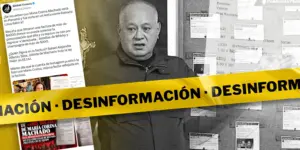
But the last time that speech aired on «El Mazo,» on October 7, 2026, Cabello walked over to the board of social media posts he reads every week shortly after Chávez’s words. There he presented a post from the fake polling firm Global Census about an expensive bill at a restaurant in Panama that María Corina Machado’s team had supposedly paid.
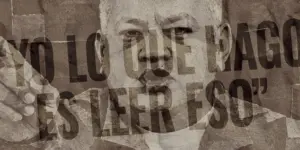
After reading out the details, he distanced himself: «Is El Mazo saying this? No, Global Census is saying this. All I do is read it.»
Diosdado Cabello, Con El Mazo Dando · OCTOBER 7, 2026
However, the bill Cabello showed was a forgery made by altering the receipt of a real order, one that had not even been placed by anyone on Machado’s team. The program’s historical database, with transcripts of 494 of the 584 episodes aired since 2014, records more than 200 phrases such as «I’m not the one saying it,» «I’m just reading» or «El Mazo is not the one saying this.»
The 57 cases debunked since 2019 come from cross-referencing the Cazadores de Fake News fact-check archive with the program’s historical database. That database was processed with the help of artificial intelligence and reviewed by hand by journalists on the team.
The anonymous accounts on X
Global Census is part of a broader ecosystem of inauthentic sources that includes fake newscasts, troll accounts and letters from anonymous informants. Their content is often cited on Con El Mazo Dando without verification, sidestepping responsibility for spreading it.
It is an «information laundering” strategy that hides disinformation, harmful political propaganda and stigmatizing content behind anonymous profiles.
In March 2024, Global Census promoted an online poll in which the popular podcast Escuela de Nada was beaten by Maduro Podcast. The win had no statistical value, but state broadcasters Venezolana de Televisión and Telesur celebrated it as real.
The Maduro administration’s Ministry of Communication and Information used the Siscom app to ask its users to vote en masse in that poll. A few days later, Global Census began presenting itself as a polling firm and forecast a victory for Nicolás Maduro in a study that, according to Cocuyo Chequea, had methodological and statistical inconsistencies.
The C-Informa coalition also linked that disinformation strategy to five other pseudo-polling firms.
The account has also served as a point of origin or amplification for disinformation. One example is the fake leak about a hotel reservation for Edmundo González Urrutia and his entourage in Costa Rica, which Cabello read on Con El Mazo Dando on January 22, 2025, and which the program kept amplifying even after it had been debunked.
But Global Census is only the most recent face of this technique. For years, Con El Mazo Dando has spread rumors, fabricated or inflated, attributed to opposition figures or infiltrators. At times, the cases have gone so viral that the program does not even mention their inauthentic origin.
La Nena de VZLA, a troll account identified in December 2020, was the first to share a misleading video about the supposedly lavish life of Leopoldo López and his wife, Lilian Tintori, in Spain. The video misleadingly used the logo of the celebrity magazine ¡Hola!. Cabello repeated the story as fact on his program twice, in January and March 2021, though without citing the inauthentic account.
The Disinformation Factory
In March 2023, Cazadores de Fake News and the C-Informa coalition documented how a network of anonymous Instagram accounts dubbed La Fábrica de Desinformación (The Disinformation Factory) operated. The network, active since at least 2019, is made up of at least six accounts with millions of followers that pose as independent Venezuelan media outlets and even spread content with an editorial tone critical of Nicolás Maduro’s government.
Their posts tend to mix viral videos and satire with real news content and political propaganda that usually favors the ruling party and discredits opposition leaders. Their content includes false statements attributed to journalists, posts that were never made and real material taken out of context.
These posts target mainly Juan Guaidó and Leopoldo López, but also María Corina Machado, Henrique Capriles Radonski and Delsa Solórzano.
In 2023, Cazadores de Fake News identified six posts featured on Con El Mazo Dando that had first appeared on La Fábrica de Desinformación. However, the program kept citing the network’s fake newscasts after that count. It did so on October 14, 2026, a week before this investigation was published, when Cabello mentioned the fake Instagram newscast «El Diario de Venezuela.»
One of the 2022 cases was the hoax about a Porsche worth more than $300,000 that Leopoldo López had supposedly bought in Spain. First published by La Nena de VZLA, it reached the program on June 22 of that year through a tweet by political leader Oliver López Cano, which Cabello showed on air.
Something similar happened in August 2024 with a video spread through the program about an alleged payment to influencer Greg Aventuras to create pro-opposition content. The video originated on the NiTanTukky account, which is linked to La Fábrica de Desinformación.
Anonymous letters and «cooperating patriots»
Many of the rumors and false stories that reach Con El Mazo Dando arrive as letters from supposed informants, infiltrators within the opposition or «patriotas cooperantes» (cooperating patriots). Cabello has used that expression since at least episode 19, in July 2014, and the program’s historical database records it at least 1,300 times across 350 episodes.
Under that label, the program spreads information that may come from real informants, intelligence agencies or police forces, or that may be baseless rumors or fabricated stories.
Cazadores de Fake News has debunked at least nine stories the program presented based on these letters or messages. They include the unsubstantiated accusation against Bishop Víctor Hugo Basabe in January 2023 and the supposed confession by Jesús María Casal about fraud by the NGO Súmate in the opposition primaries in November 2023.
They also include the false mental health diagnoses attributed to María Corina Machado in letters signed by supposed anonymous informants, in March 2024.
To these cases add the letter Cabello read on May 15, 2024, attributed to a supposed former Colombian ambassador, which linked Edmundo González and journalist Leopoldo Castillo to the CIA. Cazadores de Fake News found no trace of that person. In that same episode, as well as in the one before and the one after, Cabello said in his own voice that González was «physically and mentally weak.»
On September 30, 2026, another letter citing an anonymous informant presented the NGO Un Mundo Sin Mordaza as the supposed operational arm of the opposition party Vente Venezuela, an accusation the organization itself rejected.
Anonymous letters are an old disinformation technique used in many countries. One of the best-known precedents is former East Germany, where a 1976 Stasi directive recommended, in a confidential manual, «the use of anonymous or pseudonymous letters» and «the targeted spreading of rumors about specific individuals» to destroy the reputation of political opponents.
Only what could be debunked
Of the 57 cases debunked since 2019, in 30 it was Cabello himself or the program that made a false, misleading or unsupported claim. In the other 27, the program read, showed or replicated content from others.
More than half, 29, were concentrated in 2024, the year of the presidential election. The figures in this investigation, however, reflect only what Cazadores de Fake News has been able to debunk. Much of what passes across the program’s board, or is mentioned in letters from «cooperating patriots,» is never verified.
On May 13, 2026, Cabello said on air that the headquarters of the Universidad Internacional de las Comunicaciones owes its existence to «a slander» that «is now called» fake news (he used the English term). He sued the newspaper El Nacional for republishing a report by Spain’s ABC that linked him to drug trafficking, and in 2022 a court awarded him the building in an auction the newspaper denounced as irregular.
For that reason, he jokingly suggested, the university should put a plaque at its entrance: «Thanks to fake news for favors received.»
Methodological note
For this investigation, Cazadores de Fake News analyzed the archive of 1,330 posts on its website and found that 238 mentioned Diosdado Cabello or Con El Mazo Dando. With the support of artificial intelligence, each one was classified according to whether Cabello or his program stated the false information, replicated it from another source, were the target of a hoax or were merely mentioned.
The team then reviewed by hand the 91 posts that attributed disinformation to them, which left 58 posts about 57 distinct events.
The second source is a database with transcripts of 494 of the 584 episodes of Con El Mazo Dando aired between February 2014 and October 2026, plus 17 special broadcasts, about 1,980 hours of recordings. The team ran automated searches in it for terms related to disinformation and propaganda, the phrases Cabello uses to distance himself from what he reads, and mentions of anonymous accounts and «cooperating patriots.»
Journalists on the team listened to every phrase from 2026 and a random sample of 40 phrases from earlier years to confirm each quote. They also separated what Cabello says in his own voice from what he reads in anonymous letters or what appears in third-party clips.
In the sample, five phrases could not be verified because the video is no longer online or the link does not match, and seven out of ten phrases were disclaimers spoken by Cabello in his own voice.
The figures are minimums because they only count the cases the organization has been able to debunk, and because automated searches do not detect phrases that the transcription recorded with errors. In addition, the investigation did not have access to 90 of the 584 episodes.
Cazadores de Fake News investiga cada caso mediante la búsqueda y el hallazgo de evidencias forenses digitales en fuentes abiertas. En algunos casos, se usan datos no disponibles en fuentes abiertas con el objetivo de reorientar las investigaciones o recolectar más evidencias.
Ver metodología