Editorial statement · Cazadores de Fake News
Denying is not fact-checking
Our position on the wave of disinformation that followed the June 24 double earthquake in Venezuela.
The earthquakes of June 24, 2026 left Venezuela facing several simultaneous emergencies. Alongside the emergency of rescue and logistics, there is also an information emergency that, in its volume and speed, is unlike anything in our records as a fact-checking organization.
At Cazadores de Fake News, we address this statement to our readers and to the international fact-checking community, because what has unfolded in Venezuela’s information ecosystem since that day poses unprecedented challenges for verification and leaves lessons that reach beyond this emergency.
A wave of mostly spontaneous misinformation
The disaster struck a media ecosystem that has been weakened for years. Dozens of independent digital outlets remain blocked in Venezuela, a situation that deepened during the 2024 presidential campaign, while newsrooms and fact-checking organizations operate with minimal staff and resources. Access to the social network X had also been restricted since August 8, 2024, though after the earthquakes several internet providers began to lift the block.
This fragile infrastructure was hit by the largest episode of information disorder we have ever documented as an organization. So far, most of the rumors, misinformation, and disinformation do not appear to come from coordinated campaigns by politicians, media, or other influential actors, but are instead generated and amplified spontaneously by ordinary citizens — a pattern seen in other documented disasters around the world.
Venezuela already knew this dynamic — from the waves of rumors in the early days of the COVID-19 pandemic, for instance, or from the recurring waves of rumors about child abductions, which we documented at Cazadores de Fake News alone in 2020, 2021, 2022, 2023, and 2024. Acute episodes like these occurred without any proven coordinated campaign behind them, driven instead by citizens’ concern for the well-being of children and adolescents.
Something similar is happening in Venezuela after the earthquakes, but on a far larger scale. It has brought us questions not only about missing children and missing people, but about where humanitarian aid and search-and-rescue teams have actually gone, and about corruption allegations and building collapses, among many other topics.
But most of these hoaxes do not appear to stem from coordinated political campaigns: they are, for the most part, content generated by ordinary users that goes viral quickly.
Some users amplify false and misleading content because it confirms their criticism of the ruling party, while others fabricate it in the belief that going viral could weaken a government they reject. Some have even launched phishing campaigns that exploit the vagueness of official announcements about government aid.
It cannot be ruled out that some political opponents of the Delcy Rodríguez administration could also be promoting coordinated campaigns of agitation, propaganda, or disinformation. But proving it requires methods capable of establishing that such campaigns exist, and so far no one has presented that proof, either publicly or in an irrefutable way.
The effects of this information earthquake have been tangible. Misinformation about a false tsunami alert — spread among residents of La Guaira state themselves, not by news media — triggered desperate movements of people that subsided only once local fact-checkers and authorities debunked it.
That particular debunk is an example of the legitimate role that both independent fact-checking organizations and official accounts can play in an emergency: to warn, to provide context, and to correct mistaken information.
Official denials in the guise of fact-checking
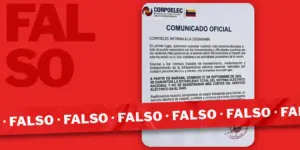
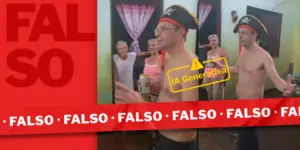
But another practice is running in parallel, and it needs to be explained. Since before the earthquake, following the appointment of Communication and Information Minister Miguel Ángel Pérez Pirela, the Delcy Rodríguez administration has operated a rapid-response account on X called “Miraflores al Momento,” which posts purported debunkings stamped with “fake” labels similar to those used by the fact-checking community.
On the “Miraflores al Momento” account, several formats coexist: videos of official statements citing casualty and damage figures narrated by Delcy Rodríguez; debunkings that single out an international outlet and one of its journalists as part of a “fake news” machine; clarifications resting on a single rescue worker’s testimony; and videos celebrating the embrace between the acting president and a survivor pulled from the rubble by foreign rescue teams. This mix of formats shows that the account’s purpose is communications, not fact-checking.
This practice of countering the disinformation that the ruling party identifies on its own is not limited to that official profile on X. Other official accounts, Telegram channels, and pro-government groups within the state-aligned information ecosystem react in a similar way, circulating content that carries “FAKE” labels normally associated with fact-checking organizations. The double earthquake did not create this dynamic, but it sharpened it to a point where we felt compelled to speak out.
It is worth clarifying the difference between the verifications produced by independent organizations and this kind of “denial” coming from official sources.
The underlying difference
Two things that look alike in form and are opposite in method
Professional fact-checking
Professional fact-checking makes public the evidence behind its conclusion, cross-checks independent sources against one another, attributes every piece of data to its origin, and corrects its own mistakes. Cazadores de Fake News, for example, has a public methodology explaining how each case is investigated, so that any reader who wishes to can reproduce our analysis and reach the same conclusions.
Official denial
By contrast, most of the interested-party denials the ruling party issues through accounts like “Miraflores al Momento” rest mainly on the statements or authority of the very party being questioned, not on irrefutable evidence. When the only proof offered is the testimony of a person, a public body, or a political spokesperson chosen by the institution itself, with no cross-checking of sources, the message boils down to something being false simply because the government says so.
It is understandable that governments want to respond to false content that affects them, especially after catastrophic events like the June 24 earthquakes, and nothing stops them from doing so. But that response belongs to the realm of official communications, and presenting it with the aesthetics of fact-checking confuses audiences about what fact-checking is and who practices it with methodological rigor.
Moreover, distrust of official sources has concrete precedents. According to research by our organization together with other teams, the ruling party drove disinformation cases and, for years, applied techniques of coordinated manipulation of hashtags and of the online conversation.
While in the current emergency we have not detected open or covert campaigns of that kind, several of the officials now leading the disaster response were linked to some of those cases.
For fact-checkers, this scenario doubles the workload, because every official denial published without evidence has to be verified as well, a task that falls on teams already stretched to their limit. Meanwhile, casting journalists and media outlets as pieces of a conspiracy weakens the press on the ground, which is the primary source for confirming or ruling out information and whose access to the affected areas must be guaranteed.
A shared responsibility
The way to build trust in official casualty and damage figures, then, should not rest on official denials bearing the “FAKE” stamp, but on joint validation among state institutions, fact-checking organizations, news media, and humanitarian and non-governmental organizations that can vouch for those figures independently.
The lesson that should stand as a precedent is that information integrity in a disaster is a shared responsibility among authorities, media, platforms, and citizens, and that no single party can protect it by defending only its own version of events, because isolated denials that lack any methodology do not ease the chaos; they only deepen public distrust.
Isolated denials with no methodology don’t ease the chaos. Fact-checking rests on public evidence, cross-checked sources, and corrected mistakes. Everything else is partisan communication.
Denying is not fact-checking.
The Cazadores de Fake News team