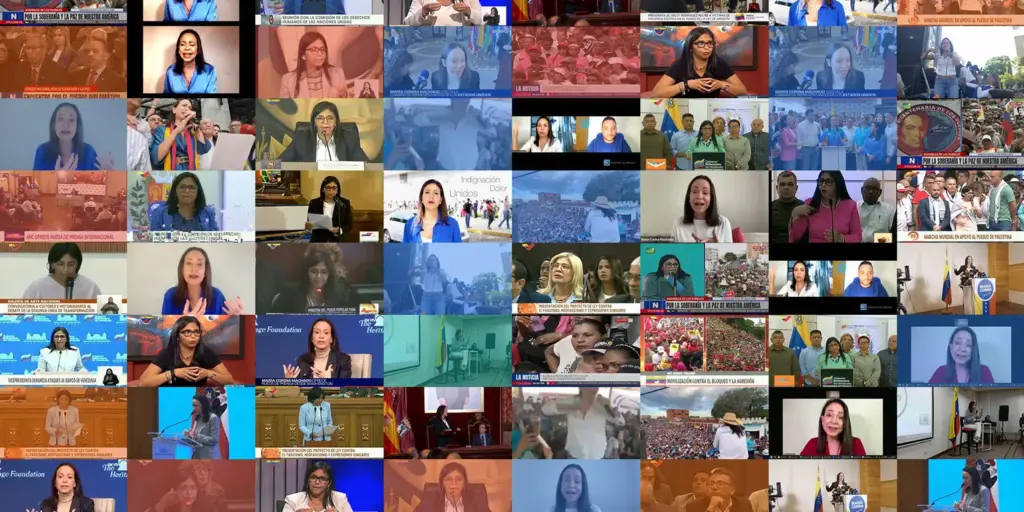
When and how María Corina Machado and Delcy Rodríguez spoke about racism over 14 years
Machado raised racism and classism to denounce the social division promoted by chavismo; Rodríguez used these topics as a political accusation against the opposition, the United States, and Trump.
Videos analyzed
Of public appearances
Videos on racism
For years, María Corina Machado followed a single argument on racism across speeches, interviews, and public events: that chavismo instrumentalized it to divide Venezuelan society along lines of class, race, and political stance. Delcy Rodríguez addressed the subject mainly as a political accusation against the ruling party’s main adversaries, particularly Donald Trump, the U.S. government, neighboring governments, and the Venezuelan opposition.
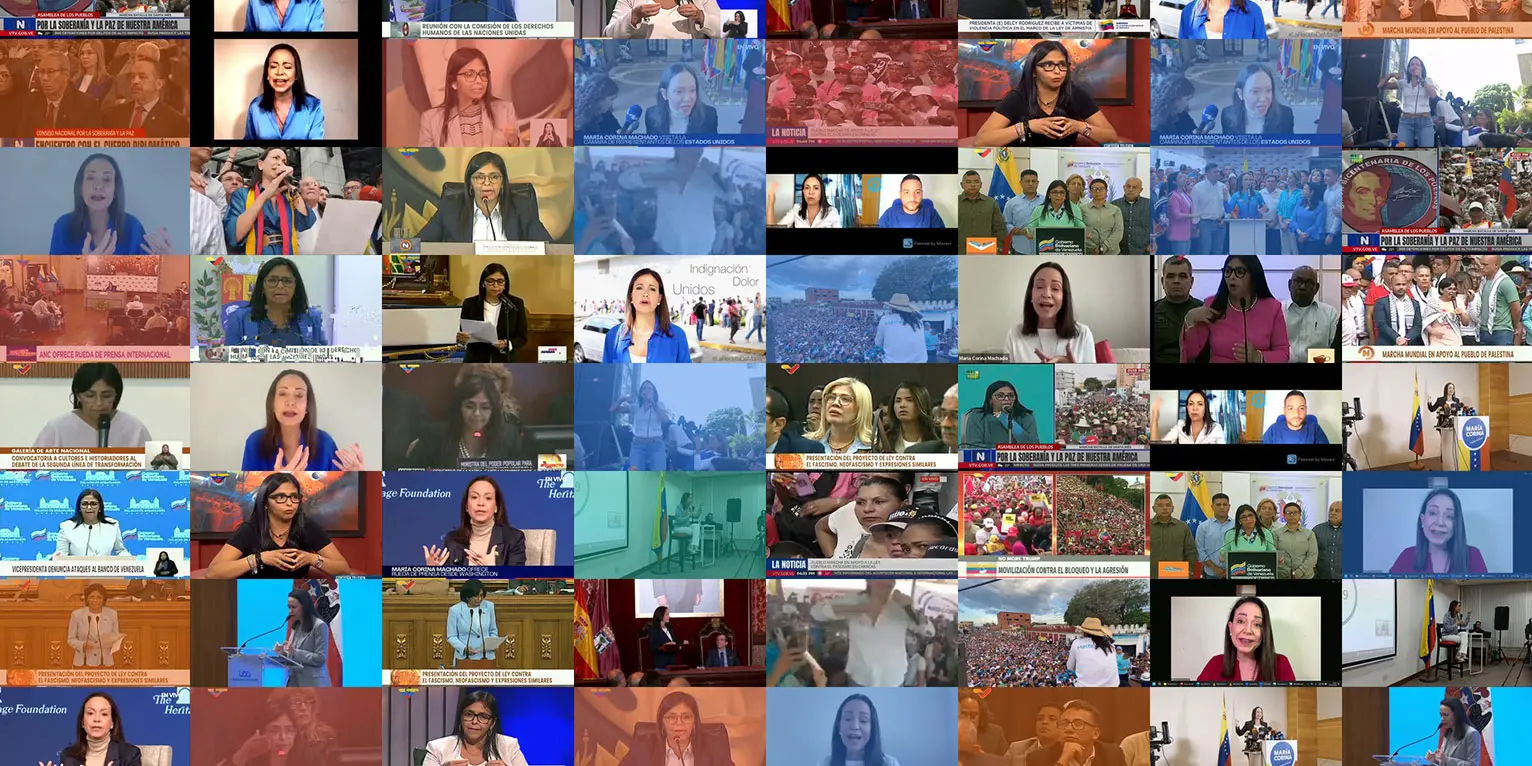
These findings come from an investigation by Cazadores de Fake News, which analyzed 971 videos published on YouTube between 2012 and 2026, covering more than 304 hours of public appearances by both leaders. In Machado’s case, the topic appears in 17 of the videos analyzed (1.7%), and in Rodríguez’s case, in 28 videos (2.9%). In most instances, the mentions take up only seconds or a few minutes of each appearance.
The results contrast with one of the central messages of the «Gran Peregrinación Nacional contra las Sanciones» (Great National Pilgrimage Against the Sanctions), launched by the ruling party on April 19, 2026, with the stated goal of asking the United States to lift sanctions against the regime. As a secondary line, that campaign introduced a narrative portraying the Venezuelan opposition, represented by Machado, as racist and classist.
That narrative emerged as a response to a rally Machado held with the Venezuelan diaspora the day before at Madrid’s Puerta del Sol. During the event, part of the audience began chanting «fuera la mona» (a racist slur, roughly «get the monkey out») in reference to Delcy Rodríguez, and singer Carlos Baute, a guest at the event, brought the microphone closer to the crowd and repeated the chant several times before Machado took the floor.
Although the racist chants resumed once Machado spoke, she ignored them and, the next day in an interview with the EFE news agency, rejected the chants and called for the focus to remain on substantive accusations against Rodríguez rather than on insults. In the days that followed, however, the ruling party and its state media reproduced the slogan on T-shirts, illustrations, and memes shared on social networks, appropriating the insult used in Madrid and turning it into a centerpiece of their messaging against Machado.
How the analysis was done
Cazadores de Fake News investigated how Machado and Rodríguez have addressed racism, Afro-Venezuelan identity, and classism across dozens of public appearances available on YouTube in which any of the terms «racismo» (racism), «racista» (racist), «raza» (race), «negro» or «negra» (Black), «clasismo» (classism), or «clasista» (classist) appears. The analysis was carried out on a database of 971 videos published between 2012 and 2026, totaling more than 304 hours.
The videos analyzed come from two of the YouTube channels that gather the largest number of speeches and public appearances by each leader. Machado’s 359 videos were taken from the channel of the Vente Venezuela party, which has archived her speeches, interviews, and public events since November 2012, while Rodríguez’s 612 videos were drawn from the channel of Luigino Bracci Roa, a Venezuelan archivist who has been compiling audiovisual material from the ruling party since March 2015.
Only 17 of the videos in which Machado speaks contain any of the keywords; in Rodríguez’s case, the terms appear in 28. Within those videos, the topic takes up only seconds or a few minutes of each appearance, making it a relatively minor subject in both leaders’ public discourse, at least until April 2026.
Racial and class division as a Chavista strategy
The central finding in the Machado videos analyzed is that nearly all her mentions of racism point to a single idea: that chavismo has instrumentalized the term as part of a deliberate strategy to divide Venezuelan society between «Blacks and whites,» «rich and poor,» «left and right,» and «those inside and those outside (Venezuela).» In 13 of the 17 identified remarks, Machado repeated this argument in speeches, interviews, and public events.
That same idea appears in two distinct contexts. In most statements, it functions as a denunciation of a deliberate strategy to fragment society and stay in power. In others, particularly during the 2023 primary campaign and the months following the 2024 presidential election, the same argument appears as evidence that the chavista strategy had failed, given that the opposition managed to bring together «rich and poor, Blacks and whites, those inside and those outside» in support of the candidacy represented by Edmundo González Urrutia.
The earliest record of any of the terms tracked corresponds to a video published on January 17, 2015, more than eleven years ago. Machado would denounce the long lines caused by shortages during Nicolás Maduro’s first term and asserted that all Venezuelans —»poor and rich, whites, Blacks, civilians, military»— were united by a common crisis. That same formula —the idea of a society united across race and class in the face of crisis— reappeared during the opposition primary campaign of September 2023, which she would go on to win, during the 2024 presidential campaign alongside Edmundo González Urrutia, and during the subsequent government repression.
On February 1, 2024, at one of her campaign events, Machado summed up this argument by stating that chavismo had used «three tools» against the country: lies, fear, and discouragement. She maintained that, on the basis of lies, the regime had tried to divide Venezuelans between «Blacks and whites, rich and poor, left, right, those outside, those inside.»
«The regime tried to divide Venezuelans between Blacks and whites, rich and poor, left, right, those outside, those inside.»
María Corina Machado · February 1, 2024
Machado’s most explicit statement on the topic took place at a forum held on September 26, 2023, when she answered a question on how she would combat discrimination against LGBTI people if she became president of Venezuela.
«I am categorically opposed to all negative discrimination on any grounds: sexual preference, ethnicity, race, creed, gender,» Machado replied, adding that discrimination against any group, however small, has social, political, and economic consequences. In the same address, she pledged, if elected president, to promote a national public campaign in favour of tolerance.
«I am categorically opposed to all negative discrimination on any grounds: sexual preference, ethnicity, race, creed, gender.»
María Corina Machado · Forum, September 26, 2023
A political accusation that shifted targets
The central finding in the Delcy Rodríguez corpus is that her references to racism and classism moved between different political adversaries depending on the moment. Until 2025, the accusations were directed mainly at the U.S. government, imperialism, and Donald Trump. To a lesser extent, they targeted the governments of Iván Duque in Colombia and Lenín Moreno in Ecuador, as well as the Venezuelan opposition whenever the ruling party was defending specific political decisions.
The 28 statements in which Rodríguez referred to racism and classism fall into four main themes: accusations framed within a global anti-imperialist, anti-colonial, and anti-fascist narrative; specific denunciations of the racism and supremacism attributed to the United States, Donald Trump, and the West; accusations against the Venezuelan opposition; and reports of xenophobia and racism against Venezuelan migrants.
More than half of Rodríguez’s interventions on racism and classism —15 of 28— were directed against the United States, Donald Trump, or Western «imperialism.» Eleven of them fall within a global anti-imperialist, anti-colonial, and anti-fascist framework, while the other four target Trump and the West specifically as particular expressions of that rhetorical framework.
For example, on August 6, 2019, then serving as executive vice president, Rodríguez responded to the executive order Trump had signed the day before, which imposed a total economic blockade on the government of Venezuela. She maintained that the U.S. president was trying to use the measure to cover up the «terrible internal situation» in the United States, following a recent wave of mass shootings. Rodríguez attributed those attacks to the «supremacist, racist, and classist hatred» that, according to her, Trump had promoted since his arrival at the White House. On other occasions, Rodríguez applied similar labels to Zionism and to the Monroe Doctrine, presented as a symbol of U.S. interventionism in Latin America.
«The supremacist, racist, and classist hatred that Trump had promoted since his arrival at the White House.»
Delcy Rodríguez · August 6, 2019
That pattern of accusations was interrupted after the capture of Nicolás Maduro on January 3, 2026, when accusations of racism and classism aimed at Trump and the United States disappeared from her speeches. A decade of disqualifications against Washington went silent within days, coinciding with Rodríguez’s assumption of office as acting president of Venezuela.
The third recurring theme targeted internal adversaries: in 9 of the 28 statements, Rodríguez accused the Venezuelan opposition, or some of its representatives, of being racist, classist, fascist, or violent. These accusations generally arose in the context of announcements or endorsements of official measures against those sectors, and they operated as a public justification for various decisions and maneuvers carried out during the Nicolás Maduro administration.
For example, on August 23, 2024, in a speech in defence of Nicolás Maduro before hundreds of ruling-party supporters, she linked opposition rejection of Maduro to classism and racism: «There you have its greatest racist expression against the humble of Venezuela, against the poor of Venezuela.» More recently, on February 23, 2026, during an event with victims and relatives tied to the ruling party, Rodríguez said again that within the opposition there persisted «that germ of hatred, of class hatred, of racism, of discrimination toward the unlike, toward the different.»
«There you have its greatest racist expression against the humble of Venezuela, against the poor of Venezuela.»
Delcy Rodríguez · August 23, 2024
The same formula was applied on four occasions against the governments of Iván Duque, in Colombia, and Lenín Moreno, in Ecuador, in response to statements and policies concerning Venezuelan migrants in those countries. On December 24, 2020, Rodríguez described as «terrible discrimination, a load of racism, xenophobia, and the generation of hatred» public statements by Duque against Venezuelan migrants in Colombia, made two weeks after a meeting between the Colombian president and Venezuelan opposition leader Leopoldo López.
An accusation that went silent and a denunciation that endures
In 2026, the accusations of racism by Delcy Rodríguez —and by the part of Venezuela’s ruling party that supports her— against Donald Trump and the United States went silent after Maduro’s capture. It is a silence that coincides with the start of formal contacts between her acting government and the Trump administration.
In Machado’s case, the mentions of racism and classism identified remained stable over eleven years, across speeches, interviews, and public events. Across the 17 interventions reviewed, no racist or classist expressions of Machado’s own were found, nor any attacks directed against any minority. On the contrary, on different occasions, Machado addressed the topic from the perspective of tolerance and non-discrimination.
In April 2026, however, these same topics reappeared as an argument used by the ruling party against the Venezuelan opposition represented by Machado. It is the same instrumentalization of race and class that the opposition leader had denounced for eleven years as part of the chavista strategy of social division.
Methodological note
Mentions of the tracked keywords in Machado’s and Rodríguez’s speech after April 19, 2026, were left out of the analysis to prevent the ruling party’s response to the Madrid incident from distorting the actual weight the topic carried over the fourteen years of public discourse analyzed.
El periodismo en Venezuela se ejerce en un entorno hostil para la prensa con decenas de instrumentos jurídicos dispuestos para el castigo de la palabra, especialmente las leyes «contra el odio», «contra el fascismo» y «contra el bloqueo». Este contenido fue escrito tomando en consideración las amenazas y límites que, en consecuencia, se han impuesto a la divulgación de informaciones desde dentro del país.
Cazadores de Fake News investiga cada caso mediante la búsqueda y el hallazgo de evidencias forenses digitales en fuentes abiertas. En algunos casos, se usan datos no disponibles en fuentes abiertas con el objetivo de reorientar las investigaciones o recolectar más evidencias.
Ver metodología