The Camina Party and its founder were hit with 38 claims. Their pattern matches both earlier campaigns against Venezuelan media outlets and a known online scam
Throughout 2026, a series of alleged copyright infringement claims has led to the removal of posts and the restriction of accounts belonging to media outlets, journalists and content creators in Venezuela and other countries. A recent case shows that these claims can be filed using the identity of the targeted person as the supposed rights owner.
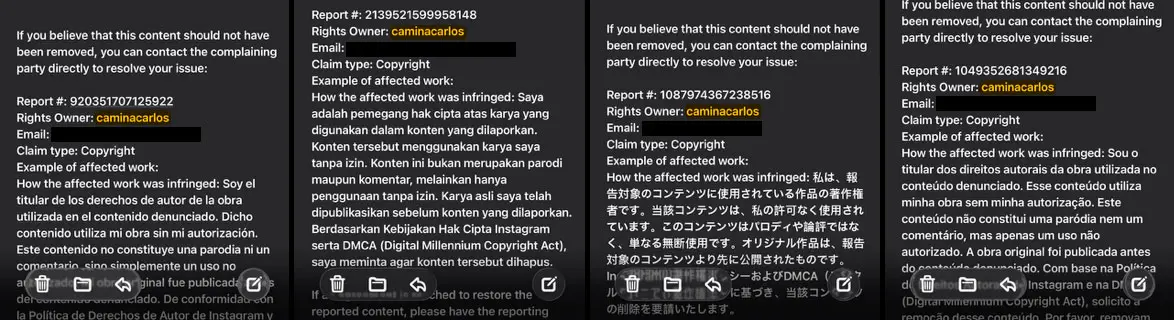
The Instagram accounts of Camina, a Venezuelan regional party, and its founder, Carlos Lozano Parra, received at least 38 alleged copyright infringement claims: 14 against @PartidoCamina and 24 against @caminacarlos. In every case, the «rights owner» field in Meta’s form was filled in with the name «caminacarlos», which is the username of Lozano’s verified account.
Lozano Parra, a former member of Venezuela’s National Assembly for Carabobo state, founded Camina in December 2018 and is its most visible figure. He told Cazadores de Fake News that he did not file any of the claims. Whoever sent them therefore used his name to get Instagram to restrict both his personal account and his organization’s.
A form that relies on the claimant’s good faith
Meta’s copyright form asks claimants to declare, under penalty of perjury, that they own the work or are authorized to act on the owner’s behalf. A recent journalistic investigation noted that the authenticity of that statement is not verified when the claim is filed, although Meta warns in its policies that fraudulent reports may lead to the termination of the filer’s account.
+56 9 2257 9962
Guárdalo y envíanos cualquier contenido que quieras verificar.
Lozano provided Cazadores de Fake News with screenshots of the email notifications Meta sent him for each claim, in which the platform identifies the supposed rights owner and the address of the person who filed the report. The screenshots show that the 38 claims were filed from 28 different email addresses, seven of which appear in at least two claims each.
The 28 addresses belong to four free email services that allow users to create accounts without strict identity verification. Some of these services are also specifically designed to protect their users’ privacy and anonymity.
In several reports, the supposed evidence meant to show that the attacker authored the content consists of links to videos on Lozano’s own TikTok account, such as one published on August 21, 2022, another from November 20, 2025, and a third from December 15, 2025. The posts flagged as infringing, meanwhile, are content that Lozano and the party published in 2022, 2023, 2025 and 2026.
In other words, the claims use legitimate content to prove authorship: the attacker uses Lozano’s name to report content that was in fact published by the politician himself or by his party.
The text of the claims also appears in four languages: 13 in Portuguese, 8 in Japanese, 4 in Indonesian and the rest in Spanish. Within each language, the wording is virtually identical and repeats the same references to lack of authorization and to the DMCA, the U.S. law that governs these claims. This uniformity suggests a translated template rather than independently written complaints.
An address to «talk» about the claims
In the middle of the wave of reports, Lozano received an email from someone who identified as the author of the claims. The message, addressed to «Caminacarlos,» offered to withdraw the claims if he replied to discuss the matter, and asked him to respond only to that email address.
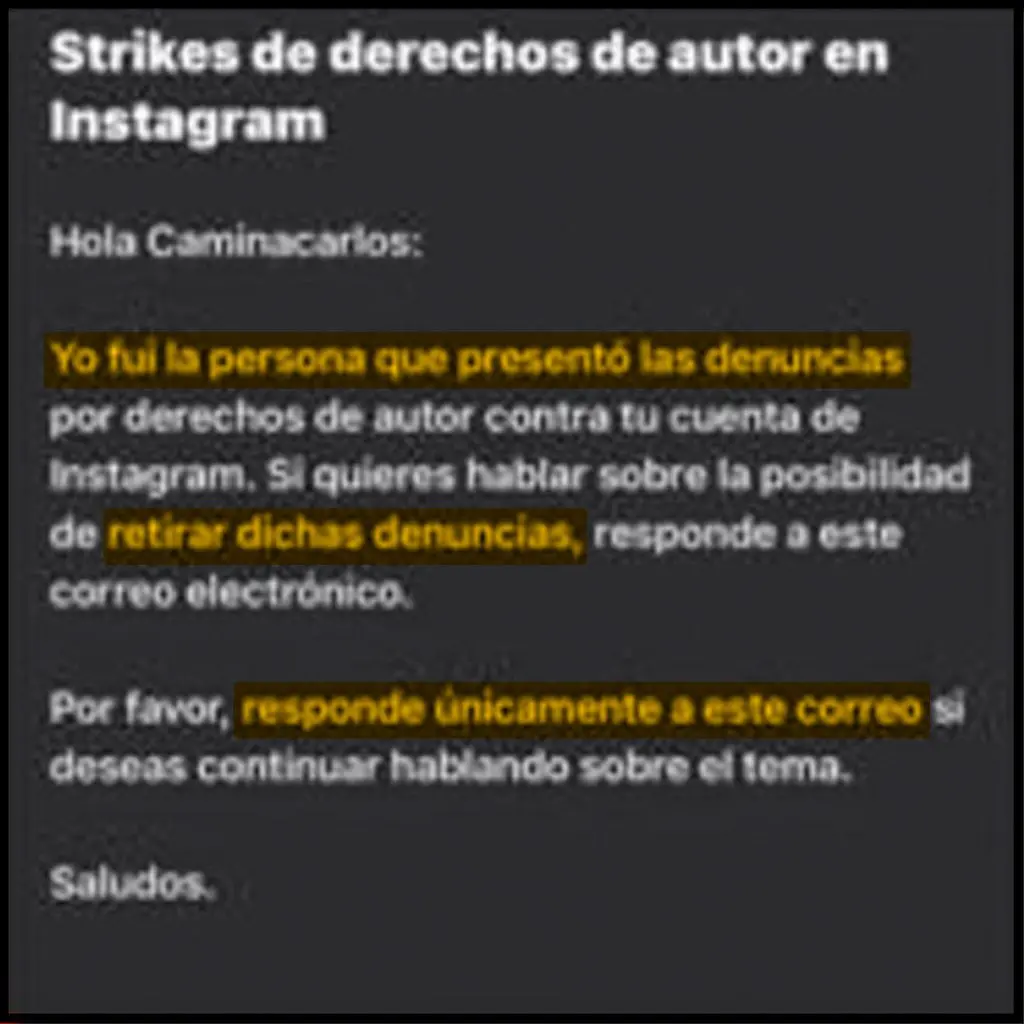
The message shares elements with a form of extortion documented internationally. An investigation published by the BBC on September 8, 2026, found that Instagram content creators had received false copyright claims, followed by messages from the people who filed them offering to withdraw them in exchange for money.
The BBC investigation cites Andrés Guadamuz, a professor of intellectual property law at the University of Sussex, who explained that Meta’s system was designed on the assumption that whoever files a copyright claim is legitimate, which makes this kind of abuse easier at scale. Asked by the BBC, Meta said it fights deceptive conduct aimed at scamming or defrauding people and businesses, and that after reviewing the cases it restored the affected content and added extra protections to those accounts.
In the Camina case, the email replicates the direct-contact mechanism outside Meta’s official channels that the BBC documented in similar cases, although it did not name a sum of money.
A tactic used against Venezuelan media and journalists
The use of copyright claims against Venezuelan accounts is not new. Throughout 2026, Cazadores de Fake News has documented how these claims took down posts by Armando.info, La Gran Aldea and Con La Lupa about businessman José Simón Elarba, and how a network of fake accounts attacked those same outlets.
Venezuela’s National Union of Press Workers (SNTP) has recorded a similar pattern against El Nacional, El Pitazo and other outlets.
The elements observed in the Camina case are consistent with more than one explanation. The email Lozano received points to the extortion scheme described by the BBC, while the successive waves against the politician’s accounts resemble the campaigns recorded against Venezuelan media and journalists.
An undetermined origin
Lozano believes the claims are political retaliation for his public activity. However, in a message sent to Cazadores de Fake News, he said that attribution must be established with technical evidence, and asked Meta to jointly analyze the reports and the infrastructure from which they were filed.
With the information available, it is not possible to determine which of the two explanations applies, nor to rule out that a politically motivated actor used the same model. That attribution requires technical data, such as the IP addresses, devices and sessions from which the claims were filed.
The account remains restricted
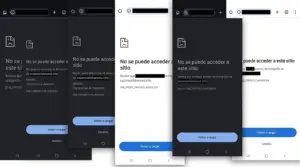
According to Lozano, his personal account was repeatedly suspended during the wave of claims, and he regained access each time after appealing. In the party’s case, however, the verification code that Instagram sends to the linked email address to recover an account has never arrived, leaving the party with no way to regain control.
«Every suspension interrupts my communication with citizens and forces me to spend time defending posts and accounts that are ours. In the case of @PartidoCamina, the missing verification code leaves the party without effective access to one of its communication channels,» Lozano said.
A Meta spokesperson told Cazadores de Fake News, in a statement sent by email, that the cases presented in the organization’s report are under review. These include the accounts of Venezuelan outlets such as Armando.info, El Nacional, El Pitazo and Válvula Política, those of the Camina Party and Carlos Lozano, and those of several content creators.
The spokesperson added that profiles and content removed in error have already been restored, and that other similar cases will also be reinstated. Meta said it works continuously to improve its systems to prevent these fraudulent schemes.
However, at the time of publication, the @PartidoCamina profile was still not visible to users.
Cazadores de Fake News investiga cada caso mediante la búsqueda y el hallazgo de evidencias forenses digitales en fuentes abiertas. En algunos casos, se usan datos no disponibles en fuentes abiertas con el objetivo de reorientar las investigaciones o recolectar más evidencias.
Ver metodología